


















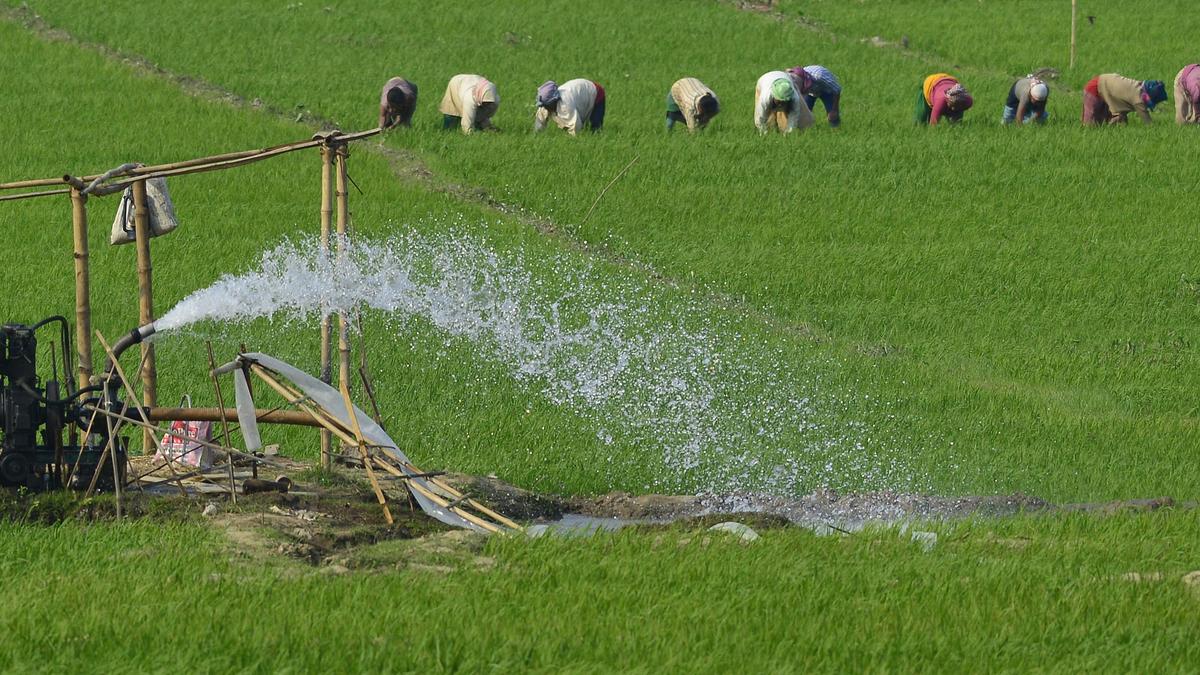
PCKL will do a cropping pattern survey study to assess electricity demand of crops and Irrigation Pump (IP) sets. Based on the findings, energy will be released for specific IP sets.
| Photo Credit: RITU RAJ KONWAR
With the agricultural requirement of electricity going up every day due to hot weather, the Power Company of Karnataka Limited (PCKL) will use Artificial Intelligence (AI) and Machine Learning (ML) to study crop patterns and provide energy accordingly.
“We are planning to do a cropping pattern survey study to assess electricity demand of crops and Irrigation Pump (IP) sets. We will also know which time and for what period the crop will need water. Based on the findings, we can release energy for specific IP sets. We will take this up on a trial basis first in a specific region and then expand it to a full-fledged project based on results,” Lokhande Snehal Sudhakar, managing director, PCKL, told The Hindu.
He also said that the programme will first be run on AI and then a pilot district will be selected for implementation. With the demand in summer season expected to go beyond 18,500 Megawatts (MW), the company also expects more energy demand for rabi crops.
Daily and monthly forecasting
From July 17, 2024, the Energy Department has been making use of AI and ML for daily and monthly forecasting of energy demand in the State. While it was first taken up as a pilot project for a period of six months, it is being used in a full-fledged manner now.
Speaking about the benefits of improved forecasting, Pankaj Kumar Pandey, managing director, Karnataka Power Transmission Corporation Limited (KPTCL) said, “Improved forecasting helps utilities source their power more efficiently by allowing them to estimate deficit/surplus across 96 fifteen-minute time blocks with higher accuracy, which in turn helps to optimise sourcing of power.”
According to the data provided by KPTCL, in 2.5 months (July 17, 2024 to September 30, 2024) due to the impact of AI and ML, the total realised profit was ₹192.97 crore. Out of this, ₹71.25 crore was purely AI and ML contribution.
Improving accuracy
“When it comes to daily and monthly forecast, our predictions are quite accurate, and we have around 5%-10% error margin. Our main aim with the project is to manage supply and demand. Once the error margin is less than 5%, we will see what else we can expand this to,” Mr. Sudhakar said.
The systems are also being used to forecast renewable energy generation which will help in better purchasing and selling of power. While the accuracy is on higher levels for solar generation, wind forecasting has proven to be tricky.
“It is essential to recognise that wind power is highly volatile and unpredictable. For instance, wind generation in Karnataka could be at 3,000 MW in one hour, drop to 300 MW the next, and then surge back to 3,000 or even 4,000 MW depending on changing wind conditions. This extreme fluctuation poses significant challenges to grid management and sourcing, leading to financial implications for the energy system and distribution companies, ultimately resulting in higher tariffs for consumers,” Mr. Pandey said.S
Published – February 25, 2025 04:54 pm IST