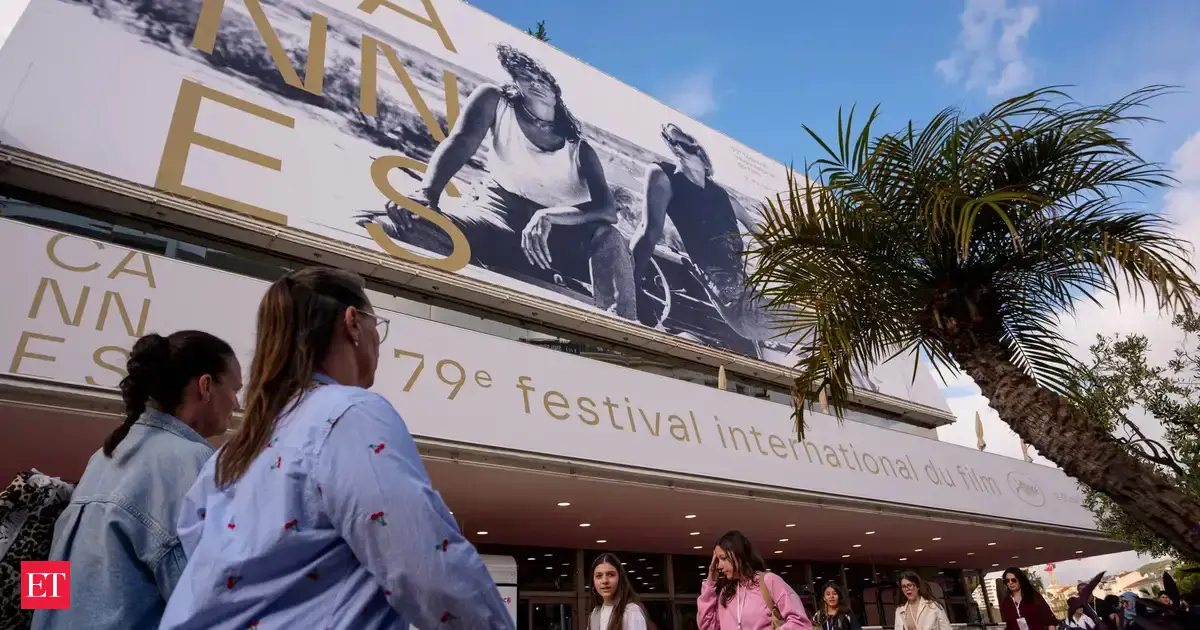










Robert, Vénéranda and Layal are all protagonists of movies at this year’s Cannes Film Festival where the official selection is packed with productions focusing on war in a sombre reflection of contemporary reality. Almost every category at the 79th Cannes Film Festival, which kicked off on May 12 and runs till May 23, is filled with war-themed movies, showing the urgency of art and artists to address violence that destroys societies across the world and, importantly, to seek solutions.
WAR & ART
In the competition section, which awards the prestigious Palme d’Or, the top prize of the festival, nearly half the selection either mentions or deals with violence in the modern world, from World Wars to the Spanish Civil War, the Cold War era and the ongoing Russia-Ukraine war. “We don’t make a film to be cautious,” said Israeli American violinist Miri Ben-Ari, the host of the festival’s opening ceremony, quoting the famous French filmmaker Jean-Luc Godard, and setting the tone for the event.
Congo Boy, the first film from the Central African Republic to be screened at Cannes; Ben’imana, the first Rwandan film in Cannes’ official selection; and The Station from Yemen in the Critics’ Week, focus the camera on rebuilding and reconciliation as the path for a better future for the three war-ravaged nations. “For someone like me who has experienced life as a refugee, art is a necessity,” says Congoleseborn filmmaker Rafiki Fariala, who directed Congo Boy, which is shown in the Un Certain Regard category that celebrates fresh voices in world cinema.
“In this violent world, our role is to put humanity back at the centre. War simplifies everything, but art restores complexity and dignity to people,” says Fariala, who fled to the neighbouring Central African Republic from his native Congo to escape war, only to find himself in the middle of violence once again.

In Rehearsals For a Revolution, part of the Special Screenings section, Iranian actor-director Pegah Ahangarani paints five portraits of her relatives and mentors to retrace more than four decades of her country’s history, from the early days of the 1979 revolution that overthrew the Shah dynasty to the beginning of the US-Israeli war on Iran this year.
World War I is the subject of acclaimed Belgian director Lukas Dhont’s new film, Coward, which is competing for the Palme d’Or, while his compatriot Emmanuel Marre explores the French Vichy regime’s collaboration with Nazi Germany during World War II in A Man of His Time. Polish director Pawel Pawlikowski probes a divided postwar German society in Fatherland, the story of a road trip from West Germany to East Germany by Nobel laureate Thomas Mann and his daughter and actor Erika in 1949. Hungarian filmmaker László Nemes, whose Son of Saul won the Oscar for the Best Foreign Language Film in 2015, has come to Cannes with his new film Moulin. It is about the arrest of French Resistance leader Jean Moulin, who refused to be broken by Gestapo torture, in 1943.
Another film set in World War II is Antonin Baudry’s The Battle of Gaulle: The Iron Age. Shown in the Out of Competition section, it is about Charles de Gaulle’s escape to London to organise resistance against the Nazis.
Christophe Dimitri Réveille’s Che Guevara: The Last Companions is a remarkable documentary that revisits the aftermath of the Cuban revolution in 1959. After the execution of Che in Bolivia in 1967, three of his last companions escape, traversing 2,400 km, into Chile, pursued by 4,000 Bolivian soldiers.
The Match is a documentary on the historic 1986 FIFA World Cup quarterfinal between Argentina and England at the Azteca Stadium in Mexico, which is incidentally the venue of the opening match of the World Cup next month. The backdrop is, again, war—the Falklands War between Britain and Argentina. Even the popular beach cinema component of the Cannes festival, the only category that is free to the public, has blood on the sands.
Ken Loach’s Land and Freedom (1995) is set at the beginning of the Spanish Civil War in 1936. Contemporary battles are not far away. The Russia-Ukraine war is reflected in Charline BourgeoisTacquet’s A Woman’s Life, the story of a surgeon and the crumbling state of public hospitals in France, while in Koji Fukada’s Nagi Notes, a Japanese military base and the recurring live fire exercises haunt the screen. “I firmly believe that with passion and a great deal of patience, we can use our stories to teach people to live together rather than fear one another,” says Fariala, about his autobiographical work. “It is a constant effort.”