

















The far-right Alternative for Germany (AfD) achieved its best-ever election result in the state election in Saxony-Anhalt, winning well over 40% of the vote and leaving all other parties far behind.
However, the party lacks the majority of seats in parliament needed to govern on its own. Because the AfD in Saxony-Anhalt has been classified as “confirmed far-right extremist” by the domestic intelligence agency, other parties announced that cooperation with the AfD was out of the question. This will make forming a government in the eastern German state quite difficult.
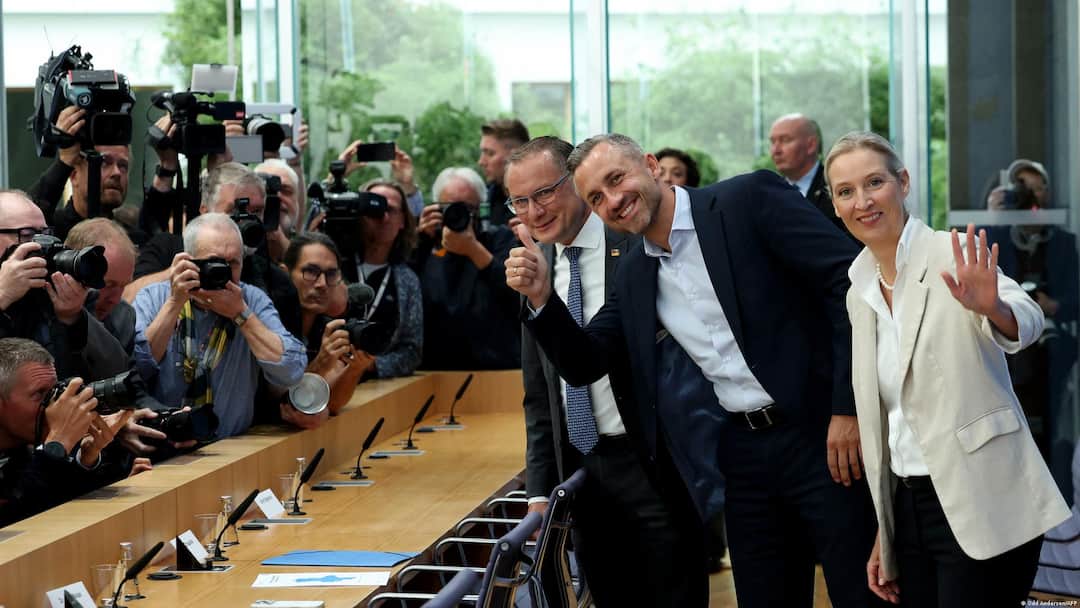
The day after the election, party leaders Alice Weidel and Tino Chrupalla held a press conference in Berlin. They were joined by the winner of the state election in Saxony-Anhalt, AfD lead candidate Ulrich Siegmund.
Even though the AfD narrowly missed its main election goal of being able to govern alone with an absolute majority, it is now more confident than ever before. The party leaders made clear that they are thinking not just about Saxony-Anhalt, but about all of Germany, and are convinced they will govern the whole country in the not-so-distant future.
“The CDU/CSU will never again be able to win a federal election. That is a fact,” party co-chair Weidel announced in reference to the center-right bloc of the Christian Democratic Union and Christian Social Union, which leads the national government.
“My stated goal is to widen the gap as quickly as possible and reach at least 40% in the next federal election,” said Weidel, who wants to become Germany’s next chancellor.
Cooperation: Yes — but with whom?
But how exactly to proceed in Saxony-Anhalt? Who does the AfD want to bring on board to form an AfD state government?
Much remains unclear even the day after the election. AfD lead candidate Siegmund repeatedly emphasized on Monday: “We extend a hand to every political actor in Saxony-Anhalt.” However, he always adds that his willingness to compromise is very limited.
“We will remain true to ourselves. We will not compromise our principles,” Siegmund said.
The AfD leaders say they want to form a stable government. This would rule out a minority government that would have to seek majorities in the state parliament on a vote-by-vote basis.
On election night, Siegmund emphasized that implementing the AfD’s platform was more important to him than the prospect of power: “There will be no compromise with me.”
Leading up to the vote, the 35-year-old AfD lead candidate repeatedly stated that he was only interested in governing alone in order to usher in a fundamental political change in Germany.
The AfD’s radical governing platform
For months, the AfD’s political program has sparked heated debates across Germany. That’s because the party wants to drastically tighten asylum and immigration policies. It wants to speed up the deportation of illegal asylum seekers and introduce a general work requirement for all other asylum seekers.
Above all, however, it wants to make Saxony-Anhalt and Germany less attractive to immigrants and is calling for a “180-degree turnaround in migration policy.” During its election campaign, the party repeatedly blamed migrants for crime in German cities and for the housing shortage.
What’s more, the AfD is planning a radical restructuring of society: It has declared war on public broadcasting, wants to cut funding for democracy projects, intends to establish a kind of vigilante group against migrants and aims to combat social diversity — all of which is laid out in its platform. And Ulrich Siegmund emphasized in an interview with public broadcaster ARD that these issues are non-negotiable.
Now, one option involves a minority government led by the AfD, in which it would need to secure support from other parties to advance its policies.
On behalf of the CDU, the party’s secretary-general, Franziska Hoppermann, categorically ruled out a coalition: “There will be no cooperation with the far left or the far right.”
Could the BSW help the AfD form a government?
The biggest unknown in this power struggle is the Sahra Wagenknecht Alliance (BSW), which cleared the 5% threshold for representation in parliament.
The small party campaigns primarily on a left-wing economic platform and — similar to the AfD — calls for a foreign policy that is more friendly toward Russia. In the past, party founder and former member of the socialist Left Party, Sahra Wagenknecht, has repeatedly expressed openness to substantive cooperation with the AfD. However, for ideological reasons, the party is not considered a particularly attractive partner within AfD circles.
As the AfD celebrated its victory into the night and even before the vote count was complete, some AfD state politicians announced that, if necessary, they intended to remain in the opposition and keep the other parties on the defensive until they could secure a majority of their own.
Disclaimer: This report first appeared on Deutsche Welle, and has been republished on ABP Live as part of a special arrangement. Apart from the headline, no changes have been made in the report by ABP Live.