












![JMA – Ninja & Deep Jandu [Official MV] Kaptaan](https://i.ytimg.com/vi/-dsfIh319s0/maxresdefault.jpg "JMA – Ninja & Deep Jandu [Official MV] Kaptaan")






Reviewed Products
|
Quick Answers

Last Updated:
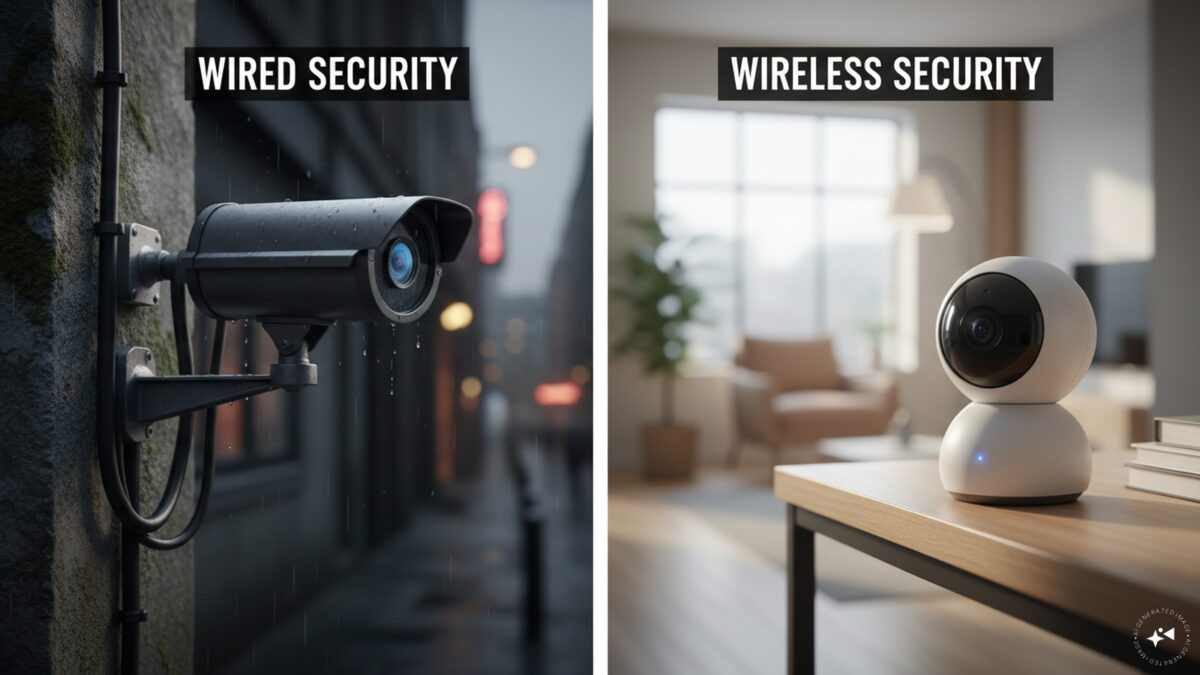
Wired and wireless security cameras offer reliability advantages from uninterrupted power and stable connections to flexible installation.




Which of these cameras should you get for your house?
Home security cameras have become easier to install and use, but choosing between wired and wireless models is still an important decision. The key difference is not simply whether a camera connects to Wi-Fi. A camera can use Wi-Fi for video transmission while still needing a continuous wired power connection.
Wired cameras generally offer dependable continuous power and can be a strong choice for fixed monitoring points such as gates, entrances and outdoor walls. Wireless cameras, meanwhile, can be easier to install because battery or solar-powered models do not need a permanent power cable at the camera.
For this comparison, we looked at six security cameras and CCTV systems across wired and wireless categories, comparing their power requirements, connectivity, installation, maintenance and suitability for different home-security situations.
Which should you buy?
Buy a wired security camera if:
You want continuous power without regularly charging a battery.
You are monitoring a fixed location such as an entrance, gate or driveway.
Your home already has suitable power points near the installation location.
You want a camera that can remain operational continuously.
You prefer a more permanent security installation.
You are comfortable with professional or more involved installation where required.
Buy a wireless security camera if:
You want easier installation without running a permanent power cable.
You need to place a camera where a power outlet is unavailable.
You are monitoring areas such as gardens, balconies, garages or temporary locations.
You prefer battery-powered or solar-assisted operation.
You want greater flexibility when changing the camera’s location.
You have a reliable Wi-Fi or 4G connection, depending on the camera.
A crucial distinction is that wireless connectivity does not necessarily mean wire-free operation. The Kasa KC420WS, for example, connects over 2.4GHz Wi-Fi but uses a 5V DC power adapter, so it is wireless for networking but wired for power.
Top picks
1. eufy Security Floodlight Camera
Price: Was – 35,392 | Now – 24,408 | Discount: 31%
2. Godrej SeeThru 720P Hybrid DVR CCTV Kit
Price: Was – Rs 21,930 | Now – Rs 19,420 | Discount: 11%
3. Kasa Smart KC420WS 4MP 2K
Price: Was – Rs NA | Now – Rs 7,826 | Discount: NA
4. eufy Security SoloCam S220 2-Cam Pack
Price: Was – Rs 37,724 | Now – Rs 20,923 | Discount: 45%
5. XUGA Cybernautt X20F 16MP 4-Lens 4G PTZ
Price: Was – Rs 19,999 | Now – Rs 11,999 | Discount: 40%
6. javiscam Wireless Indoor Security Camera
Price: Was – Rs 9,999 | Now – Rs 3,599 | Discount: 64%
Quick comparison
| Feature | Wired security camera | Wireless security camera |
| Main power source | Continuous wired power | Battery, solar or other wire-free power |
| Installation | Usually more involved | Generally easier |
| Power reliability | High when mains power is available | Depends on battery/solar availability |
| Internet connection | Can use Wi-Fi, Ethernet or other connection depending on model | Usually Wi-Fi or 4G |
| Battery charging | Not normally required | Usually required unless solar-assisted |
| Cable management | Required for power and sometimes data | Minimal for wire-free models |
| Continuous recording | Generally better suited | Depends on battery and model |
| Portability | Low | Higher |
| Maintenance | Lower battery-related maintenance | Battery charging or solar performance needs attention |
How does a wired security camera work?
A wired security camera receives continuous electrical power through a cable. Depending on the model, the same installation may also carry video or network data, while some cameras use a separate Wi-Fi connection for transmitting footage.
This continuous power supply is one of the biggest advantages of wired cameras. A camera such as the eufy Floodlight Camera requires a constant 110-240V power supply and is hardwired, even though its video connection is wireless through 2.4GHz Wi-Fi.
This makes wired cameras particularly useful for locations where you want the camera to remain active without worrying about battery levels. Outdoor entrances, driveways and fixed surveillance points can benefit from this arrangement.
Where wired security cameras perform best
Wired cameras are particularly useful when a suitable power connection is already available near the monitoring point. They can be a practical choice for homeowners who want a permanent installation rather than moving the camera around.
The Godrej SeeThru 720P Hybrid DVR CCTV Kit is a more traditional example. Its hybrid DVR supports analogue and IP cameras, with recording and remote-monitoring capabilities, making it suited to a fixed CCTV setup.
The Kasa KC420WS takes a different approach. It uses 2.4GHz Wi-Fi to transmit footage but receives power through a 5V DC adapter, meaning the network connection is wireless while the power connection remains wired.
Where wired security cameras struggle
The main disadvantage is installation flexibility. Running a power cable to an outdoor location can require drilling, cable routing or an electrician, particularly when the camera needs a permanent mains connection.
A wired camera can also be difficult to relocate once installed. If you move the camera to another part of the house or garden, the power connection may need to be changed as well.
How does a wireless security camera work?
A wireless security camera generally uses Wi-Fi or 4G for connectivity and does not require a permanent wired power connection when it is designed as a battery- or solar-powered model.
The eufy SoloCam S220 is an example of this approach. It has a built-in 6,500mAh rechargeable battery and an integrated solar panel, and eufy describes the camera as wire-free. The company says three hours of sunlight per day can keep the camera running under suitable conditions.
Wireless models can therefore be installed in locations where running a power cable would be inconvenient or expensive. However, wireless does not automatically mean maintenance-free.
Where wireless security cameras perform best
Wireless cameras work particularly well for gardens, balconies, side passages, garages and other locations where there is no convenient power outlet.
Solar-powered models can be especially useful outdoors. The XUGA Cybernautt X20F is a 4G PTZ camera described for outdoor solar-powered use, with four camera lenses, pan-and-tilt functionality, night vision and two-way audio.
The javiscam wireless indoor camera is more suitable for indoor monitoring. Its wireless design and built-in battery make it useful when users want a small camera that can be placed without keeping it connected to a power cable. javiscam’s wireless camera range includes models with long standby battery operation.
Where wireless security cameras struggle
The biggest limitation is power management. Battery-powered cameras eventually need charging, while solar models depend on adequate sunlight and suitable installation.
Wireless cameras can also depend heavily on network quality. A camera may remain powered but still become difficult to access remotely if the Wi-Fi or 4G connection is weak.
Another consideration is recording. Battery-powered cameras are often designed around motion-triggered recording to conserve energy rather than continuous recording. The eufy SoloCam S220, for example, does not support continuous recording.
Wired vs wireless security cameras: Which is actually better for homes?
If reliability means continuous power and predictable operation, wired cameras have the advantage. They do not depend on battery charge levels, and a properly installed camera can remain powered around the clock as long as the electrical supply is available.
Wireless cameras, however, have a major advantage in installation flexibility. A battery- or solar-powered camera can be installed in a location where running a power cable would be impractical.
The distinction becomes even more important when considering Wi-Fi. A camera should not be called wire-free simply because it connects to Wi-Fi. The Kasa KC420WS demonstrates this clearly: it communicates through Wi-Fi but requires a 5V DC power adapter.
For a fixed front gate, driveway or outdoor entrance with an available power connection, a wired camera can be the more dependable long-term choice. For a garden, balcony or remote corner without convenient electrical access, a battery or solar-powered wireless camera can be more practical.
Which is better for Indian homes?
Wired cameras are generally more suitable when the priority is continuous monitoring and the installation location has reliable electrical power. They can also make sense when homeowners want a permanent security setup.
Wireless cameras are more suitable when installation flexibility matters more. Solar-powered 4G cameras can also be useful in locations where Wi-Fi and conventional electrical wiring are difficult to arrange.
For many homes, the best approach may actually be a combination. A permanently powered camera can cover the main entrance or driveway, while a wireless camera can monitor a garden, balcony or another difficult-to-wire area.
The key is therefore not to assume that one technology is automatically more reliable. Wired cameras generally win on continuous power, while wireless cameras win on installation flexibility.
Common usage scenarios
| Common usage | Wired security camera | Wireless security camera | Better choice |
| Main entrance | Reliable continuous power | Suitable if wiring is difficult | Wired |
| Front gate | Good for permanent surveillance | Useful where power is unavailable | Wired |
| Driveway | Continuous monitoring | Useful for locations without nearby power | Wired |
| Garden | Requires power cable | Easier to install without cabling | Wireless |
| Balcony | Cable routing may be inconvenient | Flexible placement | Wireless |
| Indoor room | Reliable for fixed monitoring | Easy to reposition | Depends on use |
| Remote property | Needs electrical infrastructure | 4G/solar can work where Wi-Fi is unavailable | Wireless |
| Long-term continuous recording | Better suited to continuous power | Battery limitations may matter | Wired |
| Temporary monitoring | Less convenient to relocate | Easy to move | Wireless |
| Concern about battery charging | No regular camera charging required | Requires charging unless solar-assisted | Wired |
| Need for flexible installation | Requires power connection | Minimal cabling | Wireless |
So, which should you choose?
If your main priority is dependable continuous monitoring at a fixed location, a wired security camera is usually the stronger choice. It is particularly suitable for entrances, driveways and other areas where a permanent power connection can be installed.
If your priority is easy installation and flexible placement, a wireless camera can make more sense. Battery-powered models remove the need for a permanent power cable, while solar-powered 4G models can extend this flexibility to outdoor or remote locations.
The most important point is not to confuse Wi-Fi connectivity with wire-free operation. A Wi-Fi camera can still require a continuous power cable, as seen with the Kasa KC420WS.
For homes with suitable electrical infrastructure, wired cameras generally offer the more dependable power arrangement. For difficult-to-wire locations, wireless cameras can provide a more practical security solution.
FAQs
1. Are wired security cameras more reliable than wireless cameras?
For continuous power, wired cameras generally have an advantage because they do not rely on battery charge. However, overall reliability also depends on network connectivity, installation quality and the camera itself.
2. Are wireless security cameras actually wire-free?
Not always. Some wireless cameras still require a power adapter. A genuinely wire-free camera normally uses a battery, solar power or another independent power source. The eufy SoloCam S220, for example, combines a rechargeable battery with an integrated solar panel.
3. Does a Wi-Fi camera count as a wireless camera?
Only in terms of connectivity. A camera can use Wi-Fi to transmit footage while still requiring a power cable. The Kasa KC420WS is an example because it connects through 2.4GHz Wi-Fi but uses a 5V DC power adapter.
4. Which is better for an outdoor entrance, wired or wireless?
A wired camera is generally better if a reliable power connection is available because it can remain powered continuously. A wireless or solar-powered camera is more convenient when running a cable to the entrance is difficult.
5. Do wireless cameras need Wi-Fi?
Not necessarily. Some wireless cameras use Wi-Fi, while 4G security cameras use a SIM connection instead. This makes 4G models useful in locations where reliable Wi-Fi is unavailable.
6. Can wireless cameras record continuously?
It depends on the model. Battery-powered cameras often use motion-triggered recording to conserve power. For example, the eufy SoloCam S220 does not support continuous recording.
7. Which is better for a home with frequent power cuts?
A battery- or solar-powered wireless camera can continue operating during a power interruption if its battery has sufficient charge. A wired camera connected to mains power may stop working unless the home has backup power.
8. Which is better for long-term home security?
For fixed locations with dependable electricity, wired cameras are generally better suited to long-term continuous monitoring. Wireless cameras are preferable where installation flexibility or the absence of electrical wiring is more important.
Disclaimer: The product descriptions mentioned in the article are solely based on the primary and secondary research conducted by our experts. To keep you ahead of the curve with these latest products, News18 utilises affiliate links. This means if you decide to shop through our recommendations, we may earn a small referral commission at no extra cost to you. Please be advised that News18 is not responsible for any claims under the Consumer Protection Act, 2019, or other applicable laws regarding the final performance, quality, or safety of these products.
Quick Answers
 Ask News18
For continuous power, wired cameras generally have an advantage because they do not rely on battery charge levels. However, overall reliability also depends on network connectivity, installation quality, and the specific camera model.
Ask News18September 21, 2026, 17:00 IST