













International
oi-Swastika Sruti

“The American Dream isn’t just about making it big; for guys like us, it’s the sheer panic of being sent back to where you started.”
– Asylum, USA by Boman Desai
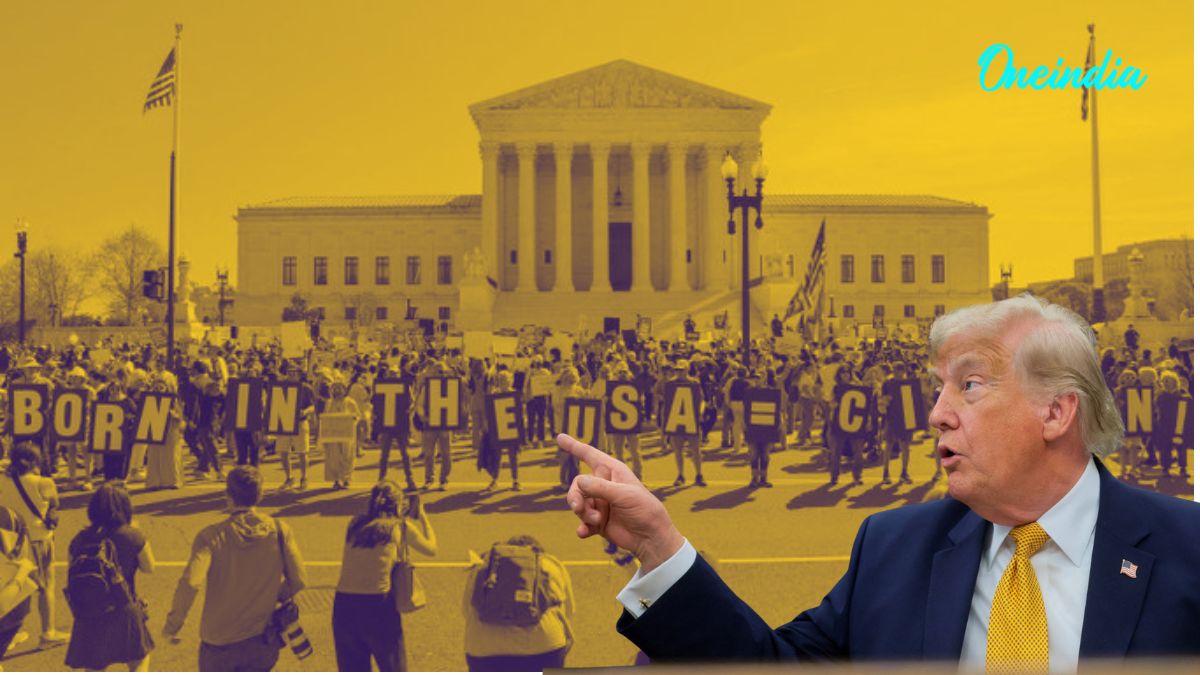
The US Supreme Court’s 6-3 ruling affirmed birthright citizenship for children born in the US, rejecting former President Trump’s executive order seeking to deny it based on parents’ immigration status and reinforcing the 14th Amendment.

For several thousand Indian students and professionals settled in America, this saying holds true in its entirety. There have been many cases where individuals have worked for years in an effort to build their careers, waiting for green cards and struggling with their immigrant status.
The US Supreme Court on Tuesday has ruled out an important case for several immigrants in America. However this move rejects President Trump’s move to deny birthright citizenship to children born in America, no matter what immigration status their parents have.
This decision becomes even more relevant in light of the huge population of Indians who have immigrated to America on temporary visas.
This was not a decision on procedural grounds (ie, POTUS can’t do this through executive order but Congress could legislate it); it is a substantive decision that says the 14th amendment requires citizenship for those born to, among others, birth tourists or those unlawfully… https://t.co/rD7ErJ17pi
— Ron DeSantis (@RonDeSantis) June 30, 2026
Understanding The US Supreme Court’s Ruling
With a 6-3 ruling, the US Supreme Court held that babies born within the boundaries of the United States are automatically US citizens, upholding a constitutional provision that has existed for over 125 years.
The decision was made with regards to the presidential executive order by President Donald Trump aimed at denying automatic citizenship to babies born to immigrants who were illegally residing within the United States, and whose parents had entered into the country temporarily using visas such as tourists and students’ visas.
The court argued that the executive order was unconstitutional because it did not take into account the 14th Amendment of the US constitution which guarantees citizenship to almost everyone born within the territories of the US.
John Roberts, the chief justice of the Supreme Court of the United States, pointed out that the ruling was guided by the historic case of Wong Kim Ark, which established that birthright citizenship is available to almost everyone born within the United States.
🇺🇸 ⚖️ The US Supreme Court on Tuesday rejected President Donald Trumps bid to restrict birthright citizenship in a blow to one of his signature anti-immigration initiatives ➡️ https://t.co/p17H16TYQ7 pic.twitter.com/yO1sMjqE21
— AFP News Agency (@AFP) June 30, 2026
What Was Trump’s Executive Order?
On January 20, 2025, the very first day of his second term as president, Trump issued an executive order targeting birthright citizenship for certain children born within the jurisdiction of the United States.
The executive order meant that children would be denied citizenship if:
- Their mother was unlawfully present within the United States while the father did not hold either US citizenship or green card status.
- Their mother was lawfully present in the US on a temporary basis on grounds of being a student or a tourist,
or
- On a work visa and the father did not hold either US citizenship or green card status.
According to Trump, such an executive order would deter “birth tourism” whereby non-US citizens visited the US for the purpose of giving birth to get citizenship for their newborn babies. After the decision by the Supreme Court, Trump encouraged Congress to enact laws that would impose such citizenship restrictions.
Abhishek Chhikara, attorney and counselor, Supreme Court of the US says, “The court has reinforced the 14th Amendment’s protection of birthright citizenship and limited the executive’s ability to reinterpret constitutional rights through executive action.”
Automatic citizenship at birth should mean something. My amendment ensures it applies to the children of citizens and legal residents, not to those who broke our laws to get here. pic.twitter.com/Xxh0WEwtlB
— Rand Paul (@RandPaul) July 1, 2026
Why Is This a Big Relief for Indians?
The verdict becomes particularly relevant in the context of Indian-American community.
According to available estimates:
There are between 5.2 to 5.5 million individuals of Indian descent residing in the US.
As many as 3.2 million Indians who have migrated legally are believed to be in the US; thus making Indians the second largest immigrant population in the US.
As many as one million Indians are caught up in the backlog of Green Cards through employment.
Hundred of thousands are in the US on H-1B, L-1 and F-1 work visas.
As many as 725,000 illegal Indian immigrants are also believed to be residing in the US.
Many professionals from India spend decades trying to get their Green Cards because of the long wait list.
Meanwhile, they keep working legally using their temporary visas and bringing up families in the US.
What Does the Ruling Mean for Indian Families?
The judgment ensures that children born in the US to Indian parents on temporary visas will continue to receive automatic American citizenship at birth.
This provides legal certainty to thousands of Indian families who are still waiting for permanent residency.
For many professionals working in the technology, healthcare, finance and research sectors, the ruling removes one of the biggest concerns about their children’s future.
Although the decision does not change visa rules or shorten Green Card waiting periods, it protects the constitutional rights of children born in America.
Indian-American Community Welcomes the Verdict
The decision has been welcomed by several Indian-American organisations.
Chintan Patel, Executive Director of Indian American Impact, said the ruling is a significant victory for immigrant families.
He noted that many Indian professionals spend years waiting for Green Cards while their children are born and raised in the United States.
According to Patel, the court has reaffirmed that those children are Americans and belong in the country regardless of their parents’ immigration status.
Birthright Citizenship Has Been Protected for Over a Century
Birthright citizenship is rooted in the 14th Amendment to the US Constitution, adopted in 1868 after the American Civil War.
The principle was firmly established by the Supreme Court in the 1898 United States v. Wong Kim Ark case, which held that almost everyone born on US soil automatically becomes an American citizen. Tuesday’s judgment reinforces that long-standing constitutional interpretation and prevents changes through executive action alone.