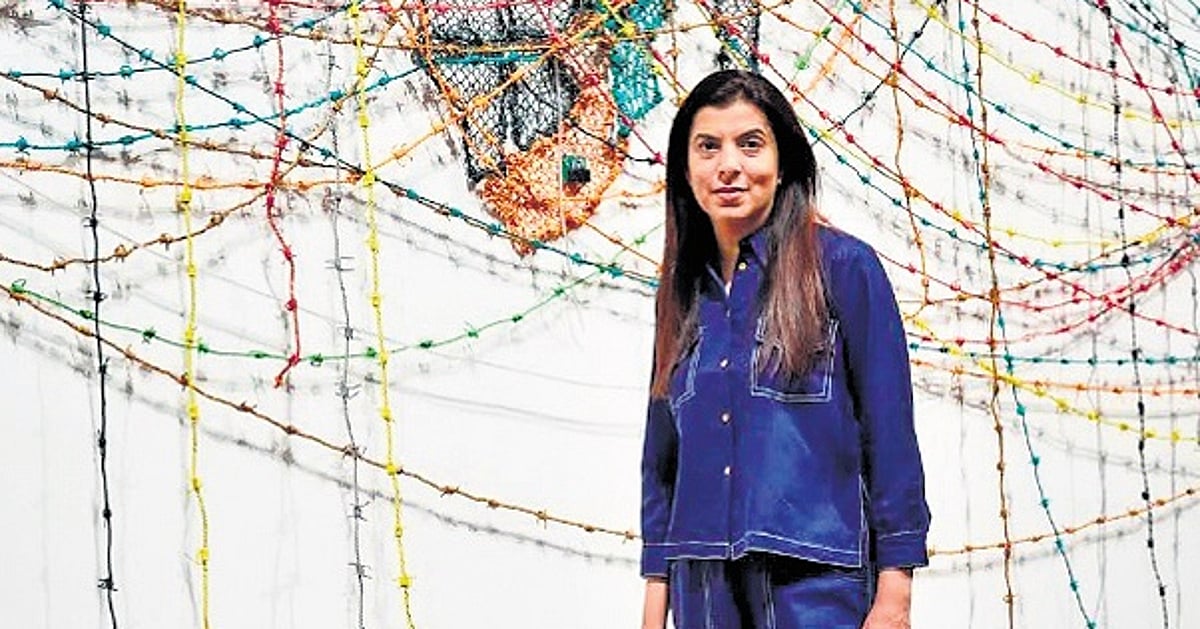


















English philosopher Herbert Spencer’s theory of evolution, popularised by Charles Darwin argues survival of the fittest, thereby leading to a natural process of selection and extinction. This theory often applies to creative minds and thinkers who flag the perils of their times. Visual artist Reena Kallat is a signaller of struggles. This time, in her ongoing solo presentation by Nature Morte in Delhi explores climate-related impact and the interconnectedness of our world.
The linkages of our contemporary lives came to be accentuated for Kallat during the pandemic years. She says, “I was collecting found images and archiving them. Patterns increasingly became more evident to me by the way climate events in one region influence those in another.” It became apparent that weather systems across the globe are interconnected and are becoming more intense, unpredictable, and amplifying the challenges we face.
Titled Zero Horizon, the show is both a physical boundary and a metaphorical one. Kallat explains, “The works include sound recordings of extinct bird species, which we only have access to through historical archives. While the birds may have disappeared because of habitat destruction, overhunting, or pollution, their songs, now lost to the natural world, are played through a sculpture, Requiem (the last call).”
The sculpture is modelled on an old pre-radar device from 20th-century warfare as a way of framing extinction as an aggressive intervention that leaves behind only silences in our history. Taking the issue further, a series of paintings show rivers drying up due to climate change, urbanisation, and environmental degradation. In Vortex, national borders that cut across contested river geographies come together to form a thumbprint. It stands out as a reminder that human mediation persistently reshapes and impacts natural landscape.