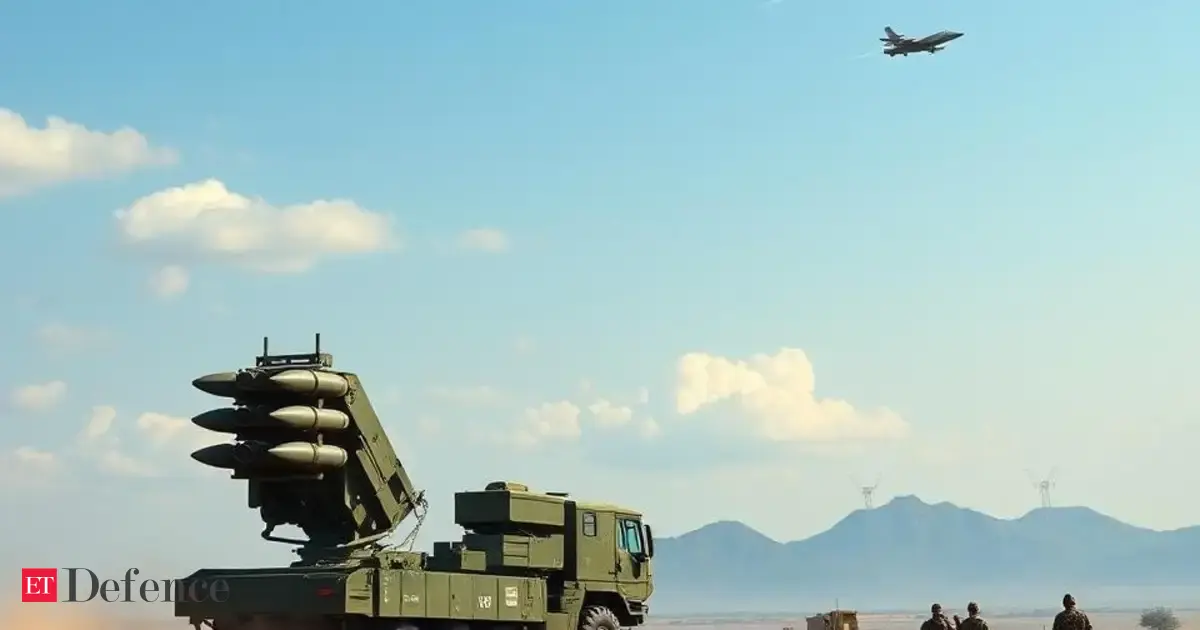


















On 15 August, Prime Minister Narendra Modi announced Mission Sudarshan Chakra, a long-term project to build a nationwide defence system that will intercept incoming threats and also strike back at the source. Days later, the Defence Research and Development Organisation (DRDO) validated this vision by successfully testing the Integrated Air Defence Weapon System (IADWS) off the Odisha coast.
Together, these two developments point to a shift in India’s defence posture: from relying on imported systems to fielding a homegrown, multi-layered shield.
The IADWS test
On 23 August, DRDO’s IADWS destroyed three targets simultaneously — two high-speed unmanned aerial vehicles and a multi-copter drone — at different altitudes and ranges.
The system integrates three technologies. The Quick Reaction Surface-to-Air Missile (QRSAM) covers aircraft, helicopters, drones, and missiles within 30 km. The Very Short Range Air Defence System (VSHORADS) provides portable, low-altitude cover. And the Directed Energy Weapon (DEW), using high-powered lasers, can disable aerial threats within 3.5 km.

Control is centralised through a command and control centre linking radars, missiles, and sensors.DRDO chief Samir V Kamat summed up the ambition: “This is just the beginning… We are also working on high-energy microwaves and electromagnetic pulses that will give us Star Wars capability.”
How a modern IADS works
The key idea behind an Integrated Air Defence System (IADS) is speed and coordination. Aircraft and missiles today travel at supersonic or hypersonic speeds, leaving only seconds to react. No single missile or radar can handle everything. An IADS combines radars, communication links, and missile batteries into one network, so that the closest, most effective weapon can engage the threat.
Based on the TOI graphic, here’s how the chain unfolds:
Radar acquires target
Ground-based radars constantly scan the sky. These can detect aircraft, drones, cruise missiles, or ballistic missiles hundreds of kilometres away, depending on radar power and altitude of the target.
Once a radar “paints” a target (locks onto it), the system begins tracking its position, speed, and trajectory in real time.
Data transfer in case of range issues
If the incoming missile or aircraft is out of range of the first missile battery, the IADS doesn’t just give up. Instead, target data is instantly passed through secure communication lines to another missile unit positioned closer to the target.
This ensures that no matter where the threat enters, the system’s combined coverage can respond.
Launch command given
Once the system decides which launcher is best placed, the command centre authorises a missile launch. The choice depends on several factors: distance, altitude, speed of the target, and availability of missiles.
This could be a Short Range Surface-to-Air Missile (SAM) for low-flying drones, a Medium Range SAM for fighter jets, or even a long-range interceptor for ballistic missiles.
Active seeker missile launched
A missile is fired at the designated target. Initially, the missile is guided by ground radar and data links. Mid-course corrections are sent to ensure it’s on track, even if the target manoeuvres.
Seeker locks on
As the missile nears the target, it activates its own seeker — a radar or infrared sensor on the missile itself. This “seeker head” allows it to home in autonomously, independent of ground guidance.
At this stage, the missile becomes very hard to evade.
Target destroyed
The missile detonates near the aircraft or missile, using either a proximity fuse (detonating when close enough) or a direct hit. The incoming threat is destroyed before it reaches its intended target on the ground.
Why IADS will matter in future wars?
The TOI graphic highlights why these systems are vital today:
- In the 1960s–70s, aircraft often relied on visual spotting and unguided bombs.
- Today, modern platforms carry stealth tech, electronic warfare pods, and precision-guided munitions.
- Aircraft fly in all weather and all terrain, so threats are not limited to cities or borders.
- Drones and cruise missiles add new layers of risk because they can fly low, slow, and evade older radar systems.
To deal with this, a smart, networked defence shield is essential. That is exactly what India’s Mission Sudarshan Chakra and IADWS are trying to create — a system where radars, missiles, and directed energy weapons work together, closing every possible gap in the sky.

Mission Sudarshan Chakra
Mission Sudarshan Chakra draws inspiration from the discus of Lord Krishna in Hindu mythology. The idea is a shield that can cover critical sites across India by 2035.
Modi said during his speech: “The entire modern system should be researched, developed, and manufactured in India, harnessing the talent of our youth. This powerful system will not only counter terrorist attacks but also strike back at the terrorists.”
It will be more than a defensive blanket. Plans include advanced surveillance, jammers, sirens, AI-enabled tracking, and the ability to launch precision counterstrikes.
Integration across domains
Chief of Defence Staff General Anil Chauhan explained the scale of the task: “I think it will entail the development of robust infrastructure and processes for the detection, acquisition, and neutralisation of the enemy’s air vectors, including the use of soft kills and hard kills, both kinetic and direct energy weapons.”
He stressed that the system will require “a colossal amount of integration” across ground, air, maritime, space, and cyber domains, with all data fused into one picture for decision-making.
Lessons from Operation Sindoor
The urgency behind Sudarshan Chakra stems from Operation Sindoor earlier this year. For nearly 100 hours, Pakistan attempted to strike Indian bases and cities with Turkish drones and Chinese missiles. India’s Integrated Air Command and Control System (IACCS) and missile defences absorbed the attacks.
The operation reinforced two points: imported systems cannot always be relied upon, and India needs a tested, layered shield for both military and civilian infrastructure. Sudarshan Chakra will expand on the IACCS, combining it with new missile layers, lasers, and cyber defence.
What the world is building for air defence systems?
India is not alone in developing layered defence shields.
United States: It has invested more than USD 400 billion in its missile defence network, including the Patriot, THAAD, and Aegis systems. Washington is now working on a “Golden Dome” — a futuristic, space-based shield that can detect and destroy missiles before they are launched.
Russia: Moscow is defended by the A-135 and A-235 ballistic missile systems, backed by the S-400 and the newer S-500. Russia has also developed counter-drone systems during the Ukraine war.
Israel: Its Iron Dome has intercepted thousands of rockets since 2011, with a claimed success rate of around 90 percent. It works alongside David’s Sling and Arrow systems, and now Iron Beam — a laser-based weapon.
China: Less is publicly known, but Beijing’s HQ-series missiles, space-based sensors, and advances in AI and cyber suggest it is building a multi-layered shield of its own.
By drawing lessons from these, Sudarshan Chakra will be tailored for India’s regional threats.
What lies ahead
India has achieved breakthroughs in missiles, radars, and sensors, but propulsion in the form of fighter jet engines remains a weak link. Programmes like Tejas and AMCA are still dependent on foreign engines. Closing this gap will be vital for future self-reliance.
Mission Sudarshan Chakra will require vast investment in space-based surveillance, AI-enabled decision systems, and offensive strike capabilities. The target is 2035, but the scale means progress must be phased — from integrating current systems to developing futuristic layers.
It will demand coordination between DRDO, the armed forces, private industry, and academia. Above all, it will require political and financial commitment over the next decade.
Missile defence is no longer optional. With drones, cruise missiles, and hypersonic weapons proliferating, nations are racing to secure their skies. Sudarshan Chakra signals India’s intent to join that club on its own terms.
If completed as planned, it will give India the ability not just to shield its people and infrastructure, but also to deter adversaries by ensuring their strikes will not succeed.
(With inputs from TOI)