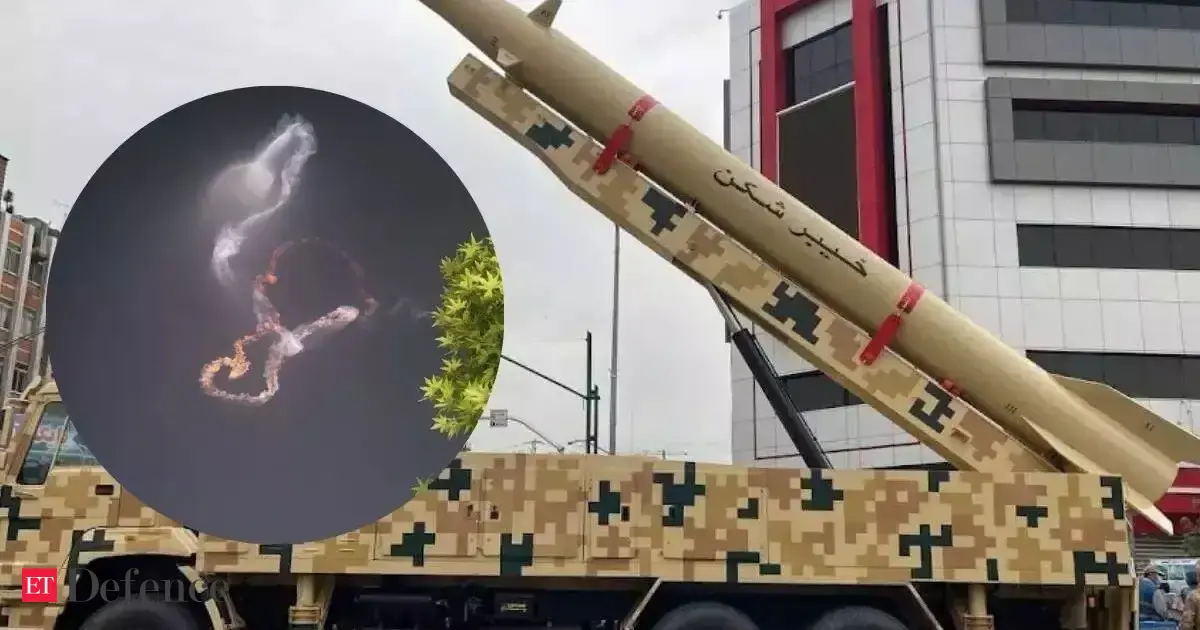


















The Sejjil is a medium-range ballistic missile developed by Iran with a strike range of around 2,000 km and a payload capacity of about 700 kg. Defence analysts say its design, speed and manoeuvrability make it significantly harder for interception systems to track and destroy.
Why the Sejjil is called the “dancing missile”
The Sejjil missile is often nicknamed the “dancing missile” because of its ability to manoeuvre during flight.
Unlike traditional ballistic missiles that follow a predictable path after launch, the Sejjil can make adjustments in the later phase of its flight. These movements can make its trajectory appear unpredictable, which complicates radar tracking and interception attempts.
Such manoeuvring behaviour forces missile defence systems to constantly recalculate the missile’s path, making interception more difficult.

How the Sejjil missile confuses air defence systems
Air defence systems rely heavily on predicting where a missile will travel after launch. Once radar detects a missile, computers calculate its path and guide interceptor missiles to that point.
But missiles like the Sejjil can alter their movement during the terminal phase of flight. Some systems may also deploy decoys or make last-minute course changes, which can trick radar and missile guidance systems.Ballistic missiles also descend at extremely high speeds when they re-enter the atmosphere, often faster than five times the speed of sound. This leaves defensive systems with only a short window to react.
When several missiles are launched together, the challenge becomes even greater because defence systems must track and intercept multiple fast-moving targets at the same time.
Iran’s Dancing Missile: Solid fuel gives it a key advantage
Another factor that makes the Sejjil difficult to stop is its solid-fuel propulsion system.
Older missiles, such as earlier liquid-fuel systems, require time to be fuelled before launch. Solid-fuel missiles are already fuelled inside the rocket motor, allowing them to be launched quickly with little preparation.
This reduces the warning time available to enemy surveillance systems and makes pre-emptive strikes against launch sites harder.
Inside Iran’s Sejjil missile programme
The Sejjil is a two-stage, solid-propellant medium-range ballistic missile developed by Iran. It measures about 18 metres in length, has a diameter of roughly 1.25 metres and weighs around 23,600 kilograms.
Iran began working on the missile programme in the late 1990s as part of efforts to modernise its long-range strike capability.
The first test launch took place in 2008, followed by another test in 2009 aimed at improving guidance and navigation systems.
Since then, the missile has become a key symbol of Iran’s indigenous missile technology and deterrence capability.
Why it matters in the current conflict
Military analysts say the Sejjil’s long range allows Iran to target distant locations without relying on proxy groups in neighbouring countries.
Its ability to move quickly, manoeuvre during flight and launch with little warning means air defence networks must respond faster and more accurately than ever.
In modern missile warfare, even the most advanced defence systems can struggle when faced with fast, manoeuvrable weapons designed specifically to evade interception.