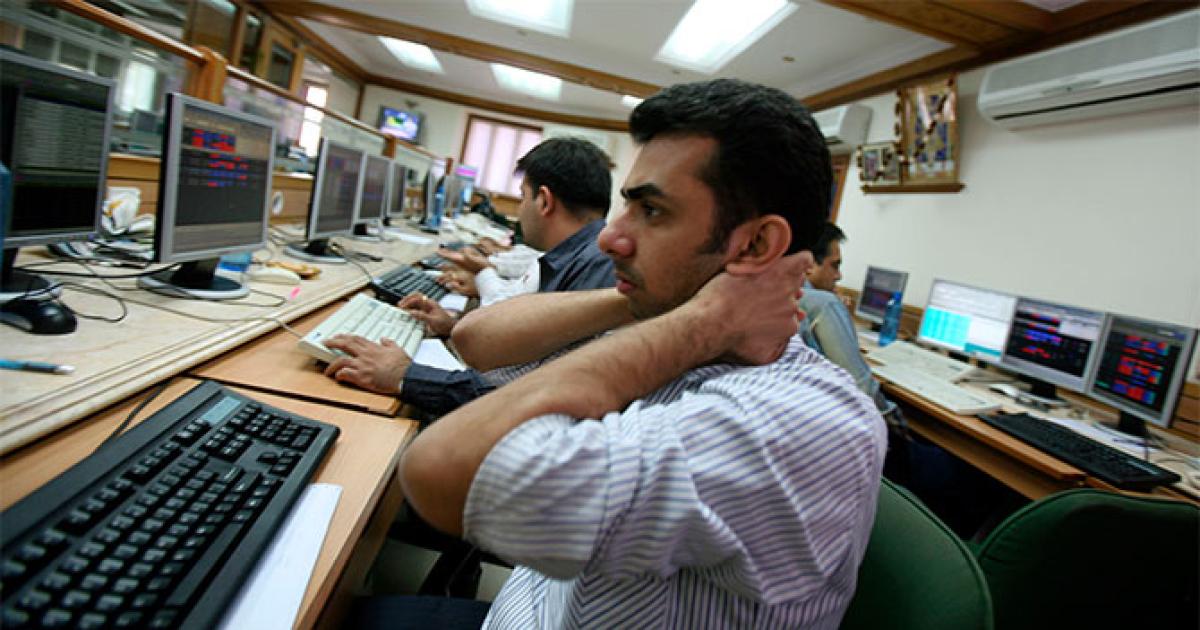















Indian benchmark indices, Sensex and Nifty, witnessed a sharp decline for the third consecutive day, with the Sensex plummeting 1,092 points, as a below-normal monsoon forecast and persistent geopolitical uncertainties rattled investor confidence.

Illustration: Dominic Xavier/Rediff
Key Points
- The Sensex plummeted 1,092.06 points (1.44%) to 74,775.74, while the Nifty dived 359.40 points (1.50%) to 23,547.75, marking the third consecutive session of declines.
- The India Meteorological Department (IMD) predicted a June-September southwest monsoon rainfall of 90 per cent of the long-period average, raising concerns about agricultural output and inflation.
- Concerns over a potential El Nino weather pattern, coupled with deficient rainfall, are expected to heighten fears of elevated food inflation in the coming months.
- Geopolitical uncertainty, particularly the lack of formal confirmation on a US-Iran ceasefire extension, also contributed to investor caution and limited risk-taking.
- Major laggards among Sensex firms included Power Grid, InterGlobe Aviation, NTPC, Mahindra & Mahindra, Tata Steel, and Bajaj Finance.
Benchmark stock index Sensex tumbled 1,092 points and Nifty closed below 24,550 on Friday amid reports of a below-normal monsoon season rainfall and geopolitical uncertainty related to the US-Iran ceasefire arrangement.

Dragged by a late-minute selling rush, the 30-share BSE Sensex tumbled 1,092.06 points, or 1.44 per cent, to settle at 74,775.74. During the day, it dropped 1,278.69 points, or 1.68 per cent, to 74,589.11.
Falling for the third consecutive session, the 50-share NSE Nifty dived 359.40 points, or 1.50 per cent, to end at 23,547.75.
Market Performance and Key Laggards
Among 30 Sensex firms, Power Grid, InterGlobe Aviation, NTPC, Mahindra & Mahindra, Tata Steel and Bajaj Finance were the major laggards.
Tech Mahindra, HCL Tech, Larsen & Toubro and Infosys were the gainers.
Monsoon Forecast Concerns
The June-September southwest monsoon rainfall over India is expected to be 90 per cent of the long-period average with a model error of 4 per cent, the India Meteorological Department said on Friday.
While the Northeast is likely to witness normal rainfall this monsoon season, the remaining parts of the country may see below normal rainfall, the weather office said. LPA refers to the rainfall recorded over a particular region for a given interval, such as a month or season, averaged over a long period of time, typically 30 to 50 years.
“The market witnessed broad-based selling pressure following the IMD’s monsoon forecasts to 90 per cent of the long-period average, raising concerns among investors.
“The prospect of deficient rainfall, coupled with the increasing likelihood of an El Nino weather pattern, has heightened fears of elevated food inflation in the coming month,” Vinod Nair, Head of Research, Geojit Investments Limited, said.
However, the downside risk appears partially mitigated by the recent moderation in crude oil prices and bond yields, he said.
Geopolitical and Global Market Impact
Brent crude, the global oil benchmark, dropped 1.52 per cent to $92.29 per barrel.
“Geopolitical uncertainty also continued to weigh on investor confidence. Although initial optimism emerged around a possible extension of the US-Iran ceasefire arrangement, the absence of formal confirmation from Washington kept global institutional investors cautious ahead of the weekend, limiting aggressive risk-taking across equities,” Hariprasad K, Research Analyst and Founder, Livelong Wealth, said.
In Asian markets, South Korea’s benchmark Kospi, Japan’s Nikkei 225 index and Hong Kong’s Hang Seng index ended higher, while Shanghai’s SSE Composite index settled lower.
Foreign Institutional Investors (FIIs) offloaded equities worth Rs 1,042.70 crore on Wednesday, according to exchange data.