















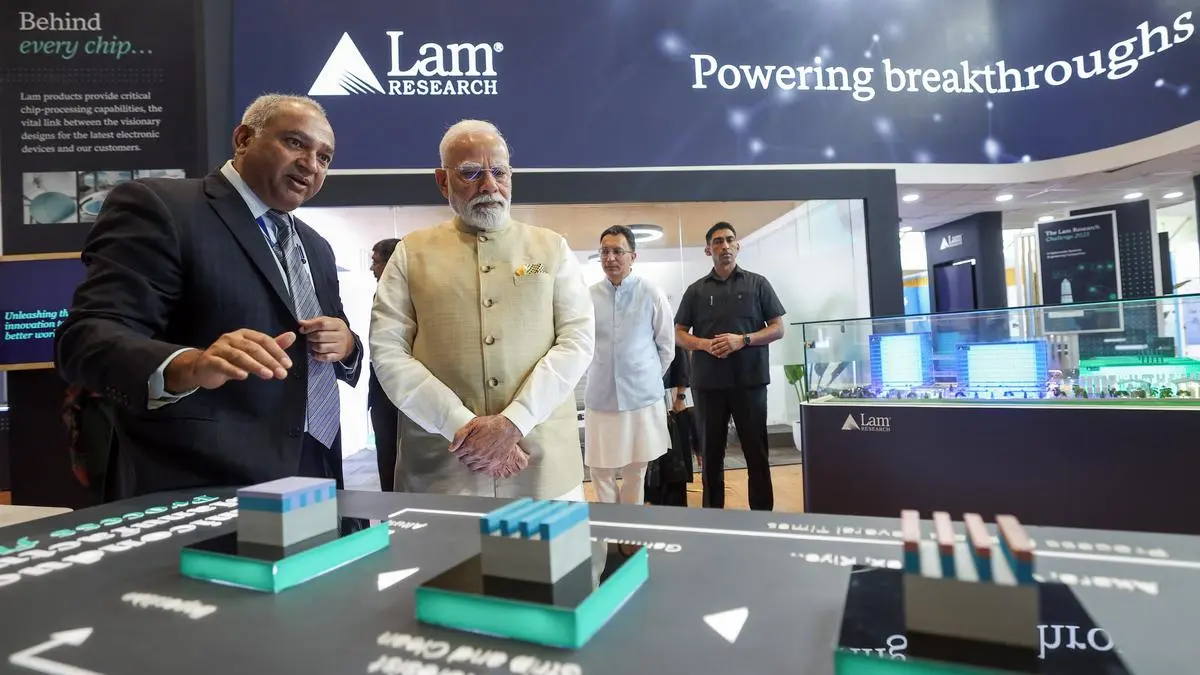
New Delhi, Sep 03 (ANI): Prime Minister Narendra Modi interacts with experts in the semiconductor field and watches various products/projects that use the technology, during the fourth edition of the ‘Semicon India’, at Yashobhoomi in New Delhi on Wednesday. (DPR PMO/ANI Photo)
| Photo Credit:
ANI
India’s chip ambitions have a massive hurdle in the extreme shortage of trained manpower in the semiconductor sector. Industry leaders warn that without a deep pool of skilled workers, the country’s semiconductor ecosystem will take years to become workable.
“There is no skill factory yet in India for the semiconductor industry as the trainings were still going on, and since these trainings are very complicated, it would take another two years for the skill-set to come in this ecosystem,” said senior officials at the Semicon India 2025 conference.
In fact, there is such paucity of skilled workforce that the industry is having to hire from overseas. Tata Electronics has hired workers from 18 countries for its semiconductor plants in Dholera, Gujarat and Jagiroad, Assam.
Speaking on the sidelines of the conference, Sandeep Kumar, Chief Executive of L&T Semiconductor Technologies, said bluntly: “These trainings are very complicated so that can’t be achieved in just one or two years.”
Kumar pointed out that semiconductor manufacturing in India would, for now, remain dependent on countries such as Taiwan, Malaysia and Singapore. In design-led segments, the imbalance is even more stark. “We talk about 20 per cent of the global design talent in India, but we know design language just like the manufacturing lines. People who are trained in manufacturing lines, they can’t design the products. The design talent that we have are outside the country at higher-end, but they are basically designing manufacturing lines for the multinational firms.”
Sriram Viswanathan, Founding Managing Partner at Celesta Capital, echoed the same concerns. “We need to really commit and focus on that area to develop the skills-set. Skilling is a very important part of this whole story – you can’t just go capitalise it, just aspire for the highest in technology without the underlying course skills – and the skills don’t materialise overnight. It takes a long time, so we have to commit to that.”
Ajit Manocha, President and CEO of Semiconductor Equipment and Materials International (SEMI), stressed that even the most advanced countries in the semiconductor race rely on others. “No country can do everything by themselves, and just like other countries India too will be going to depend on many countries to have a ‘complete semiconductor playbook’. Even China is dependent on other countries for most advanced nodes… they depend on the US and South Korea. There are not too many companies making memory chips in China. They are depend on importing from companies like Micron.”
Manocha argued that India has potential in its young workforce, but warned against expecting quick fixes. “The good thing is we have the raw material (fresh graduates) here and we can train them either locally or send them to other countries to get them right experience. That’s the give and take that will happen. So, time will come when there’s more manufacturing units here then people will actually start having a good balanced approach. Not to import so many talent from outside, but start with some raw talent and train them on the job. That’s the way things will evolve.”
PM Modi also spoke about India’s relentless reform journey in this sector, which includes building robust infrastructure and emphasis on skilling as well as innovation during the closed door meeting with the CEOs
Earlier today, interacted with leading CEOs from the world of semiconductors during SEMICON India 2025. Their confidence in India’s potential is evident and they are betting big on India as a global hub for semiconductor innovation and manufacturing. I talked about India’s… pic.twitter.com/9Eba4xyLRI
— Narendra Modi (@narendramodi) September 3, 2025
The government’s India Semiconductor Mission (ISM) says it is enabling collaborations and partnership programmes with domestic and international industries, institutions and agencies to drive research, commercialisation and skill development. Ashwini Vaishnaw, the Minister of Electronics and IT, has announced plans to train 85,000 semiconductor engineers in India over the next decade.
For now, though, the gap between ambition and execution remains glaring. With companies forced to import talent from abroad and industry leaders warning that skills “don’t materialise overnight,” India’s semiconductor dreams remain hostage to a critical shortage of manpower.
Published on September 3, 2025