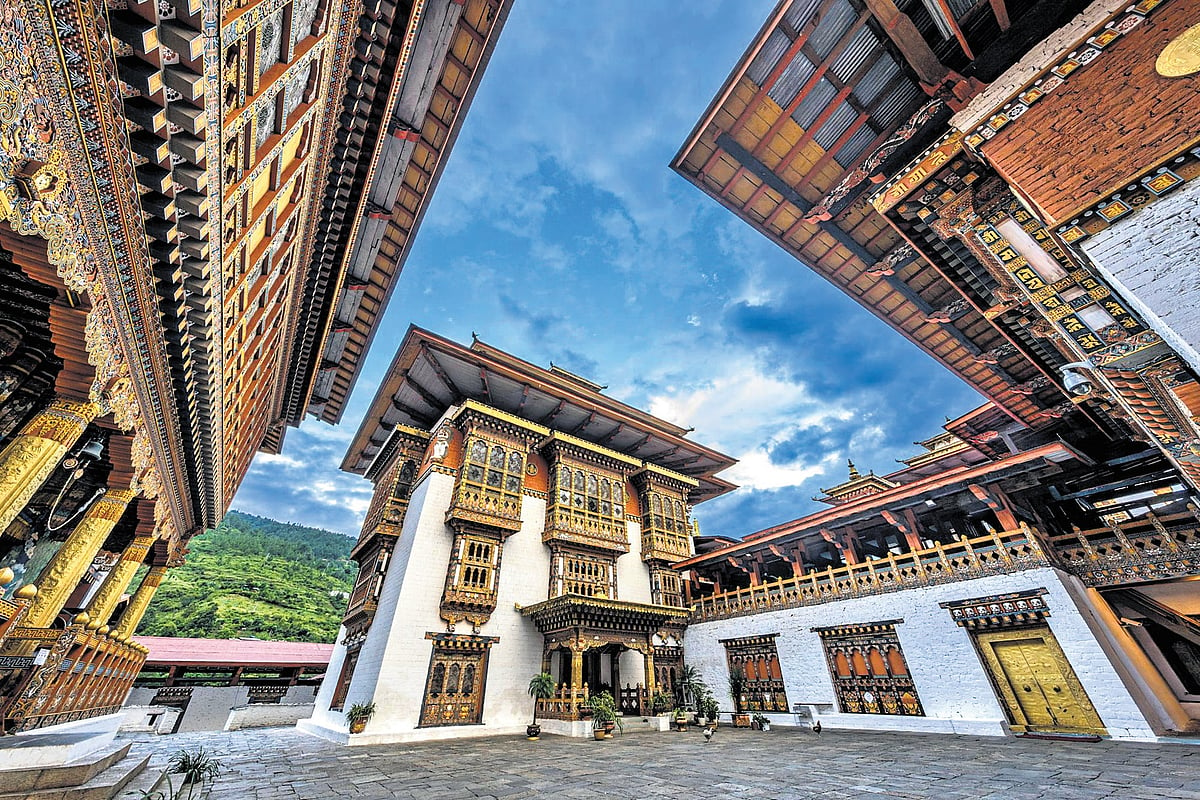














Marc Dujardin, in his study, From Living to Propelling Monument, writes: “Contrary to most medieval castles in Europe that are relatively dead monuments and literally ‘empty’ places, Bhutanese (dzongs) are still in use today. The dzong still accommodates the same political, religious and logistic functions it was originally designed for.” Every dzong stands tall as a living monument, representing the past in the present.
The architecture is distinctively traditional: wattle-and-daub construction, rammed earth, stone masonry, and intricate woodwork. Traditionally, no plans were drawn on paper and the dzongs, with massive sloping walls, overhanging roofs, high inset windows, and dark bands of colourful painting, seem to be an organic part of the country’s rugged landscape. “The red, white and yellow used in the woodwork stands out against the lush greenery and blue waters,” Phunstso says.
Thimphu, about 110 km from Haa, is home to Tashichho Dzong, the ‘Fortress of the Glorious Religion’, which has been the seat of the Royal Government of Bhutan since the capital moved from Punakha to Thimphu in 1962. “The annual Thimphu Tshechu is held here every September. Locals and tourists gather to witness the music and cultural performances that reveal Bhutan’s many traditions and customs,” Phunstso says.
About 72 km from Thimphu stands one of Bhutan’s most beautiful dzongs. Punakha Dzong, also known as the ‘Palace of Great Happiness’, is situated at the confluence of the Pho Chhu and Mo Chhu, and has been the site of momentous events such as the coronations of kings and the present king’s wedding. The dzong is also the winter residence of the official monk body, the dratshang.