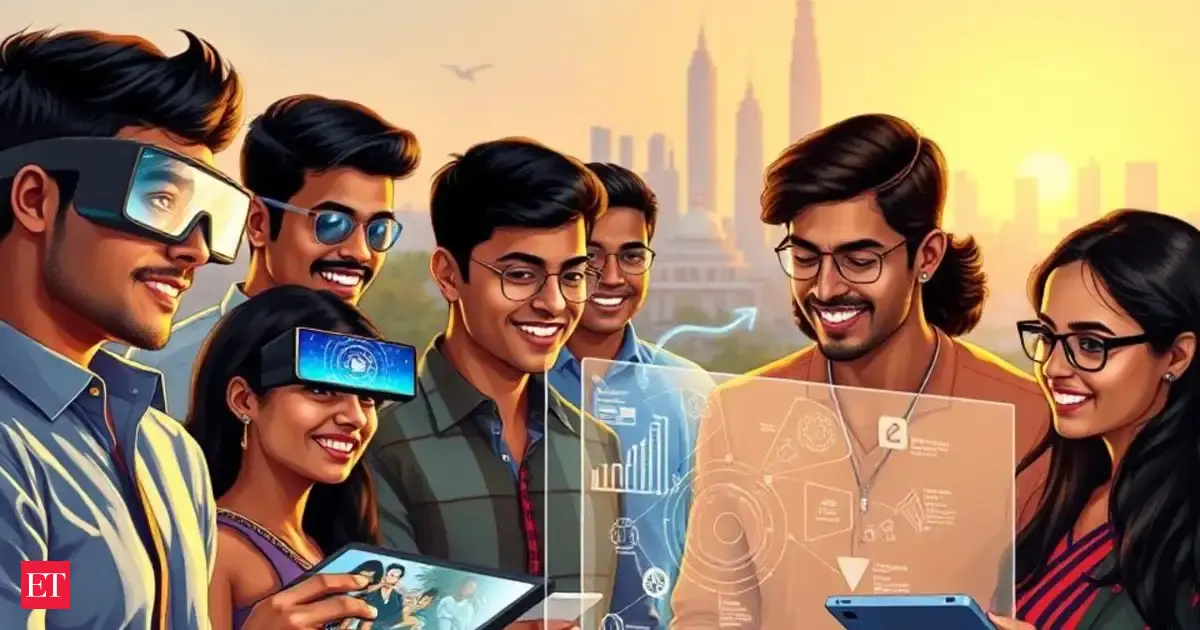



















“India now has the world’s best digital infrastructure,” said Salone Sehgal, founder and managing partner at Lumikai. “Cheap data, smartphone penetration and UPI have unlocked monetisation at scale.”
The market, now valued at $13.8 billion and growing at about 17% year-on-year, is increasingly being driven by consumer spending rather than just user expansion.
“The interactive media market is growing 17–18% year-on-year on a large base, now approaching $14 billion,” said Aditya Deshpande, principal at Lumikai.
The shift reflects a deeper behavioural change across India’s digital ecosystem. Users who were earlier largely consuming content passively are now more engaged, transacting within apps and spending on digital experiences.

Consumer spends are rising across categories, led by microtransactions, subscriptions and in-app purchases, signalling a maturing market where willingness to pay is improving alongside access.
New formats like microdramas, short-form episodic content designed for mobile consumption, have grown from virtually zero to about $300 million within a short span, highlighting how quickly new categories can monetise in India’s mobile-first ecosystem. Despite their short duration, these formats are driving strong engagement and repeat usage, pointing to early signs of habit formation.Video continues to dominate the market at $5.4 billion, while social and community platforms account for $4.9 billion, spanning social media, dating, astro-devotional services and interactive learning. Together, these segments form the bulk of the market, even as newer formats gain traction.
Audio is also emerging as a fast-growing category, expanding 29% to reach $0.4 billion, led by podcasts and audio series, underscoring the growing diversity of content formats that are finding paying audiences.
Gaming remains one of the strongest monetisation engines within interactive media, with the segment at $1.5 billion and projected to grow to $3.2 billion by 2030, driven by in-app purchases and advertising.
“Gamers spend about 4.5 times more than other app users,” Sehgal said.
Despite regulatory disruptions in real money gaming, monetisation metrics have remained resilient. Payer conversion has held steady at around 25%, while average revenue per paying user in mid-core games is about $15, indicating sustained spending behaviour among core users.
The animation and VFX segment, meanwhile, has reached about $1.6 billion and is beginning to transition from a services-led model to one focused on building original intellectual property for domestic and global audiences.
Sehgal said the industry is increasingly moving towards IP ownership alongside services, supported by improving production capabilities and rising demand for high-quality digital content.
Artificial intelligence is emerging as a key layer across the ecosystem, reshaping how content is created, distributed and monetised.
“We are moving from content delivery to intelligent experiences,” Sehgal said.
AI is already improving productivity by about 25% and reducing costs by 15–30%, while accelerating production timelines, particularly in content and animation workflows. This is expected to lower barriers to content creation even further, while intensifying competition for user attention.
Investor sentiment towards the sector is also evolving as the market matures.
“All key conditions are now in place — a large market, meaningful revenues, a strong founder pipeline and visible exit pathways,” Sehgal said.
Investors are increasingly prioritising sustainable growth and quality of revenue over scale, signalling a more disciplined phase of capital allocation across digital businesses.
At the same time, industry leaders see a growing opportunity for India to emerge as a global exporter of digital content, aided by improving production capabilities and the reach of digital distribution.
“Films like RRR and Baahubali have shown that Indian stories can travel globally,” Sehgal said.
With a young, mobile-first population and rising disposable incomes, the next phase of growth is expected to be driven by platforms that combine content, interactivity and personalisation.
The report describes this as the beginning of a new interactive era in digital media, comparable to earlier shifts driven by search, social and video platforms.
“India’s $14 billion interactive media market is just the opening act,” it said.
As monetisation deepens and new formats scale, the sector is set to become a defining pillar of India’s digital economy, with growth increasingly tied to how effectively platforms convert engagement into revenue.