




















Last Updated:
Mir claimed that the level of state suppression in PoJK has eclipsed the conditions seen in traditional conflict zones




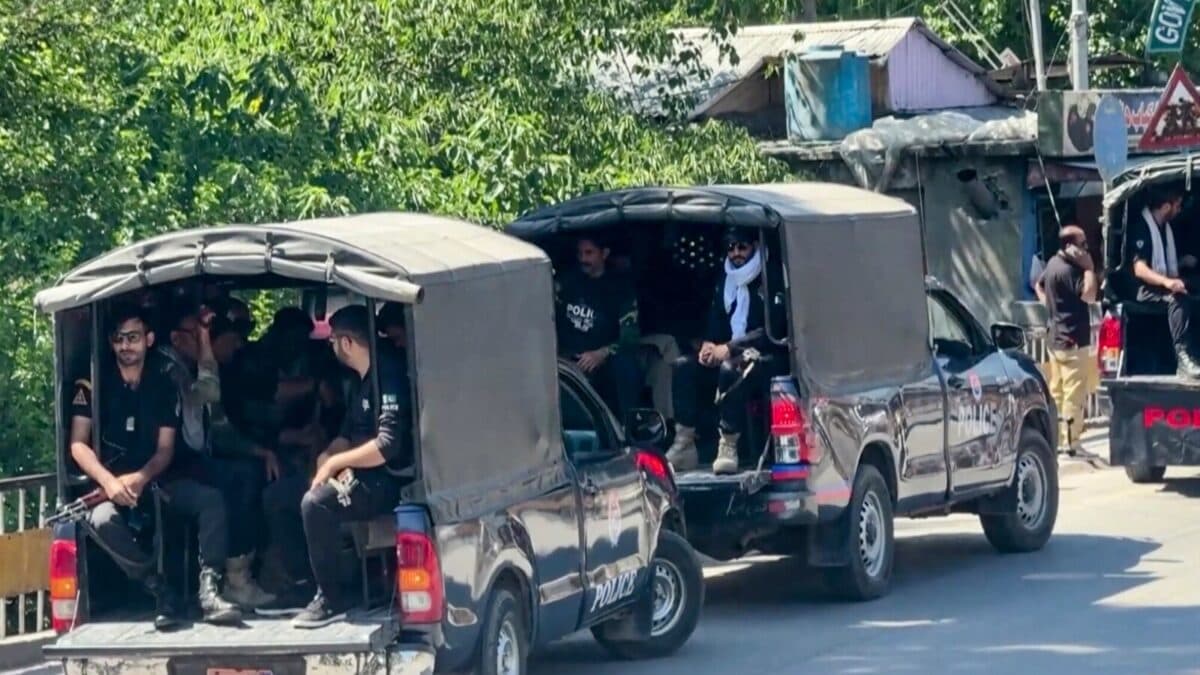
Police officials patrol an area amid the ongoing violence in PoK. Image/PTI
The deep-seated socio-political instability within Pakistan-occupied Jammu and Kashmir (PoJK) has reached a critical flashpoint following the release of a harrowing audio message by the prominent leader of the Joint Awami Action Committee (JAAC), Shaukat Nawaz Mir. Speaking from an undisclosed location where he remains in hiding, Mir issued a desperate, wide-ranging appeal directed at local residents, the overseas Kashmiri diaspora, and international human rights institutions. In his address, the fugitive leader alleged that the Pakistani state apparatus and its powerful military establishment have unleashed a ruthless campaign of structural terror and widespread violence across the region to completely crush the ongoing civil rights movement.
According to the latest audio transmission, Pakistani security forces and intelligence agencies have systematically targeted members of the JAAC Core Committee alongside the families of overseas Kashmiris who have provided financial or vocal support to the agitation. Mir detailed severe human rights violations, claiming that law enforcement personnel are forcibly entering private residences, destroying personal property, and routinely disrespecting women during aggressive nocturnal raids. The leader stated that numerous committee members have been arbitrarily detained, while a significant number have been subject to enforced disappearances, leaving their families with no information regarding their whereabouts or safety.
Allegations of a Heavy-Handed Crackdown
Characterising the ground reality in the territory as a humanitarian crisis, Mir claimed that the level of state suppression in PoJK has now eclipsed the conditions seen in “traditional conflict zones like Gaza and Srinagar”. He warned that the establishment has escalated its response to the level of a systemic massacre, asserting that paramilitary detachments have been given mandates to use direct, lethal force against any individuals gathering in the public square. This aggressive posture has reportedly led to a rising toll of casualties, with Mir confirming that multiple local residents have been killed during recent clashes in the volatile districts of Kotli, Neelum, and Rawalakot.
Top intelligence sources monitoring the frontier told CNN-News18 that these escalating developments have thoroughly exposed the absolute, top-down control that Islamabad exerts over the peripheral region. The deployment of heavily armed paramilitary forces—including the Punjab Rangers and Federal Constabulary—coupled with the imposition of a complete communications and internet blackout, reveals that the local political structures in Muzaffarabad possess no genuine autonomy or administrative authority when confronting direct public dissent. The state-enforced digital isolation has left local populations entirely dependent on smuggled audio recordings and backchannel networks to communicate the unfolding ground realities to the outside world.
Narrative Battles and Institutional Resistance
In a bid to manage the fallout and neutralise the expanding popular base of the JAAC, Pakistan’s security establishment is actively attempting to shift the public narrative. Intelligence updates reveal that state media and official channels are building a counter-narrative, claiming that the core JAAC leadership is operating in collusion with and receiving direct tactical instructions from “a hostile neighbouring country”. This institutional strategy aims to delegitimise a grassroots civil movement that originally emerged from basic economic grievances regarding flour subsidies and inflated electricity tariffs, reframing it instead as a national security threat.
Despite these heavy-handed tactics by law enforcement, including systemic harassment and arbitrary detentions, the civil resistance shows few signs of an immediate retreat. The complete marginalisation of local elected officials by Islamabad’s security managers has deepened the alienation of the frontier population, transforming a struggle for civic rights into a broader, highly volatile confrontation over constitutional identity and human rights.
About the Author

Group Editor, Investigations & Security Affairs, Network18
Read More