

















Last Updated:
NASA and Lockheed Martins X-59 supersonic test plane has completed key ground tests, moving closer to first flight and aims to prove quieter overland supersonic travel.




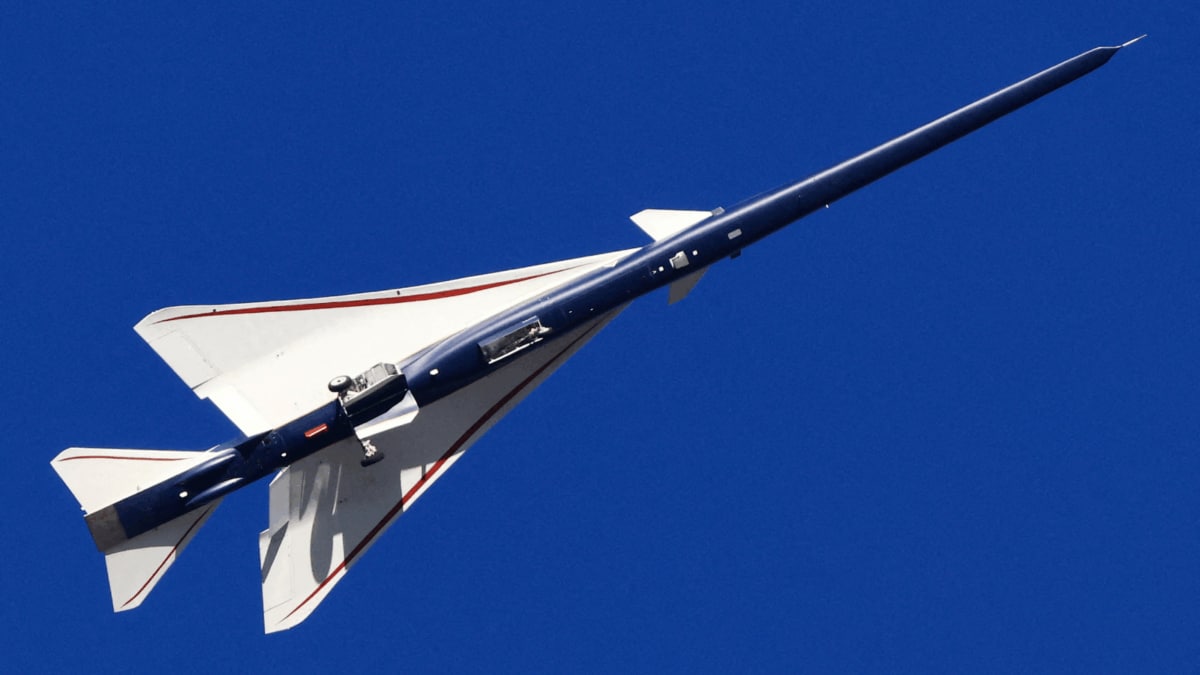
NASA’s experimental quiet supersonic X-59 Quesst aircraft taking off. (Image: Reuters)
NASA’s experimental X-59 aircraft has cleared another major milestone in its quest to revolutionise supersonic travel, with engineers successfully completing a series of critical ground tests ahead of its first flight.
The X-59, developed by NASA in partnership with Lockheed Martin under the agency’s Quesst (Quiet SuperSonic Technology) mission, is designed to fly faster than the speed of sound while dramatically reducing the disruptive sonic boom traditionally associated with supersonic aircraft.
According to NASA, recent tests focused on verifying the aircraft’s systems, controls and performance as engineers prepare for its maiden flight. The agency said the results mark an important step toward demonstrating whether quiet supersonic travel can become a practical reality.
What Makes the X-59 Different?
Conventional supersonic aircraft generate a loud sonic boom when they break the sound barrier, often causing windows to rattle and creating noise levels that have led regulators to ban commercial supersonic flights over land in many countries.
The X-59 aims to solve that problem.
The aircraft features a distinctive elongated nose measuring nearly one-third of its total length. Its unique shape is designed to spread out shock waves generated during supersonic flight, transforming the traditional explosive sonic boom into a much quieter sound often described as a “sonic thump.”
NASA hopes the technology will pave the way for a new generation of commercial aircraft capable of flying faster than sound without disturbing people on the ground.
Preparing for First Flight
The latest round of testing involved validating the aircraft’s avionics, flight control systems and integrated performance under simulated operational conditions.
Engineers also conducted taxi tests and system evaluations to ensure the aircraft can safely transition from ground operations to flight testing.
The X-59 is expected to reach speeds of around Mach 1.4, or approximately 1,500 kilometres per hour, while cruising at altitudes of about 55,000 feet.
Why the Mission Matters
NASA’s Quesst mission is not just about building a new aircraft but gathering scientific data that could influence future aviation regulations.
Once flight testing begins, the X-59 will fly over selected communities across the United States. Researchers will collect public feedback on the aircraft’s reduced noise signature and use the findings to help regulators determine whether restrictions on overland supersonic flight can be reconsidered.
If successful, the project could eventually enable commercial airlines to significantly reduce travel times on long-distance routes.
The Future of Supersonic Travel
Supersonic passenger travel largely disappeared after the retirement of the Concorde in 2003. While several companies have since explored next-generation supersonic aircraft, concerns over noise, fuel consumption and environmental impact have remained major obstacles.
NASA believes the X-59 could provide the data needed to overcome one of the industry’s biggest challenges — the sonic boom.
With ground testing progressing successfully and preparations for the maiden flight continuing, the aircraft is now one step closer to demonstrating whether quiet supersonic travel can become a reality in the decades ahead.
United States of America (USA)
Read More