















At Louvre Abu Dhabi, art begins long before the first canvas comes into view. Beneath Jean Nouvel’s extraordinary floating dome — an architectural masterpiece that filters sunlight into a hypnotic ‘rain of light’ — visitors pause between sea-facing terraces and medina-inspired passageways. Conversations drift between admiration for the collection and awe at the building itself. Few cultural institutions manage to create such an immediate emotional atmosphere; fewer still make architecture feel inseparable from the art it houses.
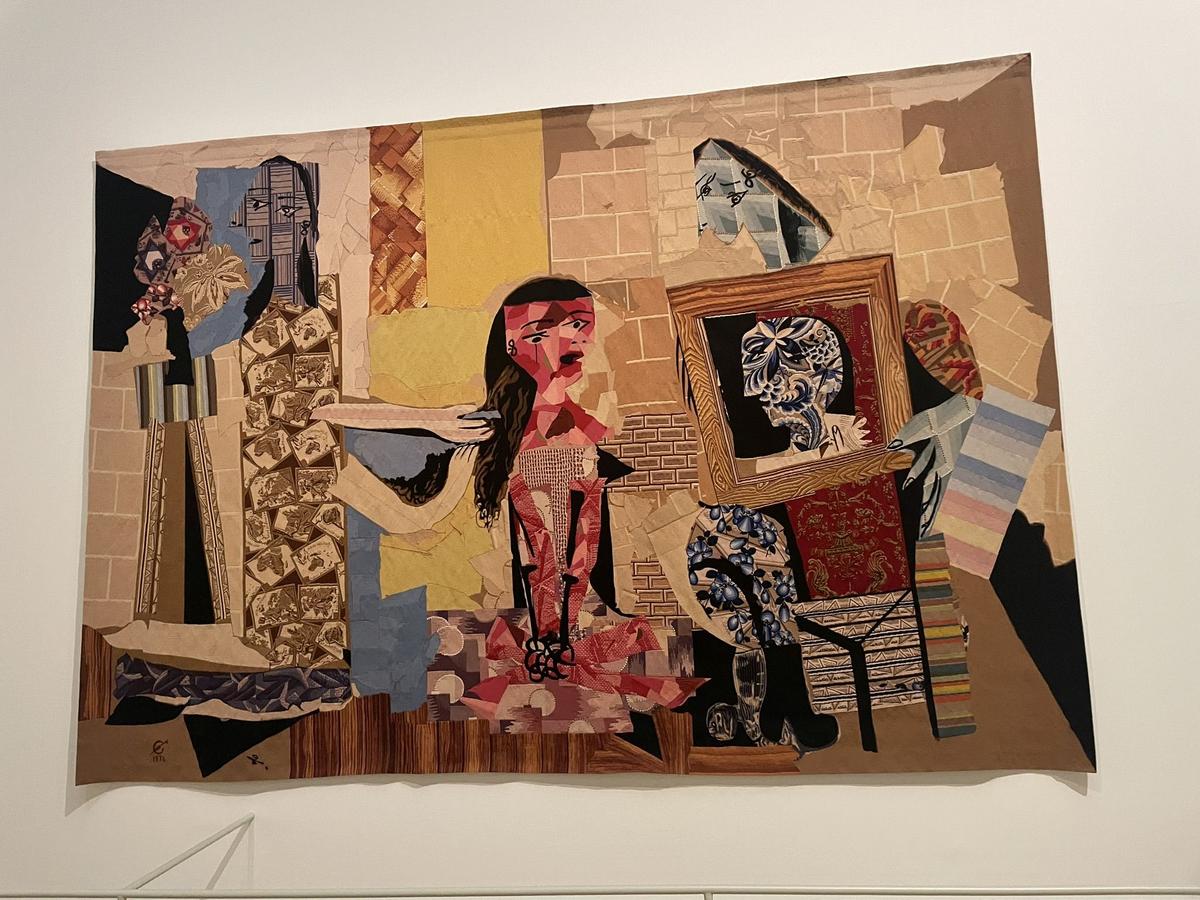
The exhibition brings together around 60 important works exploring Picasso’s fascination with the human figure.
| Photo Credit:
Neeta Lal
This is precisely what makes Louvre Abu Dhabi unique. Rising from the waters of Saadiyat Island, like a contemporary cultural mirage, the museum reimagines what a global institution can be — not simply a repository of masterpieces, but a meeting point between East and West, antiquity and modernity, intimacy and scale. Every gallery unfolds with cinematic precision, each corridor framing the sea, the sky, or a carefully-choreographed shaft of light. It is a museum, designed not only to be visited, but to be felt.
Then you step into Picasso, the Figure and suddenly, the noise disappears.
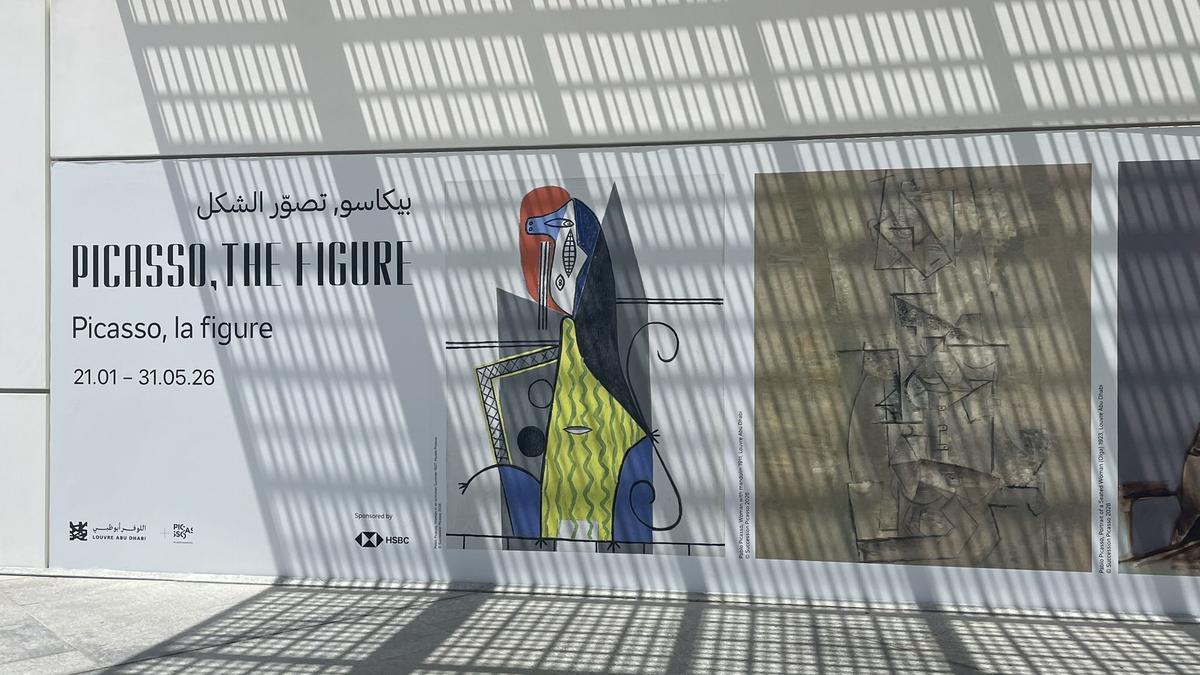
Presented by Louvre Abu Dhabi, in collaboration with Musée National Picasso-Paris and France Muséums, the exhibition running until May 31, marks a defining moment for the museum: its first exhibition, dedicated entirely to Pablo Picasso, the artist who more than any other reshaped the language of 20th-century art. Within moments of entering, one thought becomes impossible to ignore: this exhibition alone feels worth the journey.
The game-changer
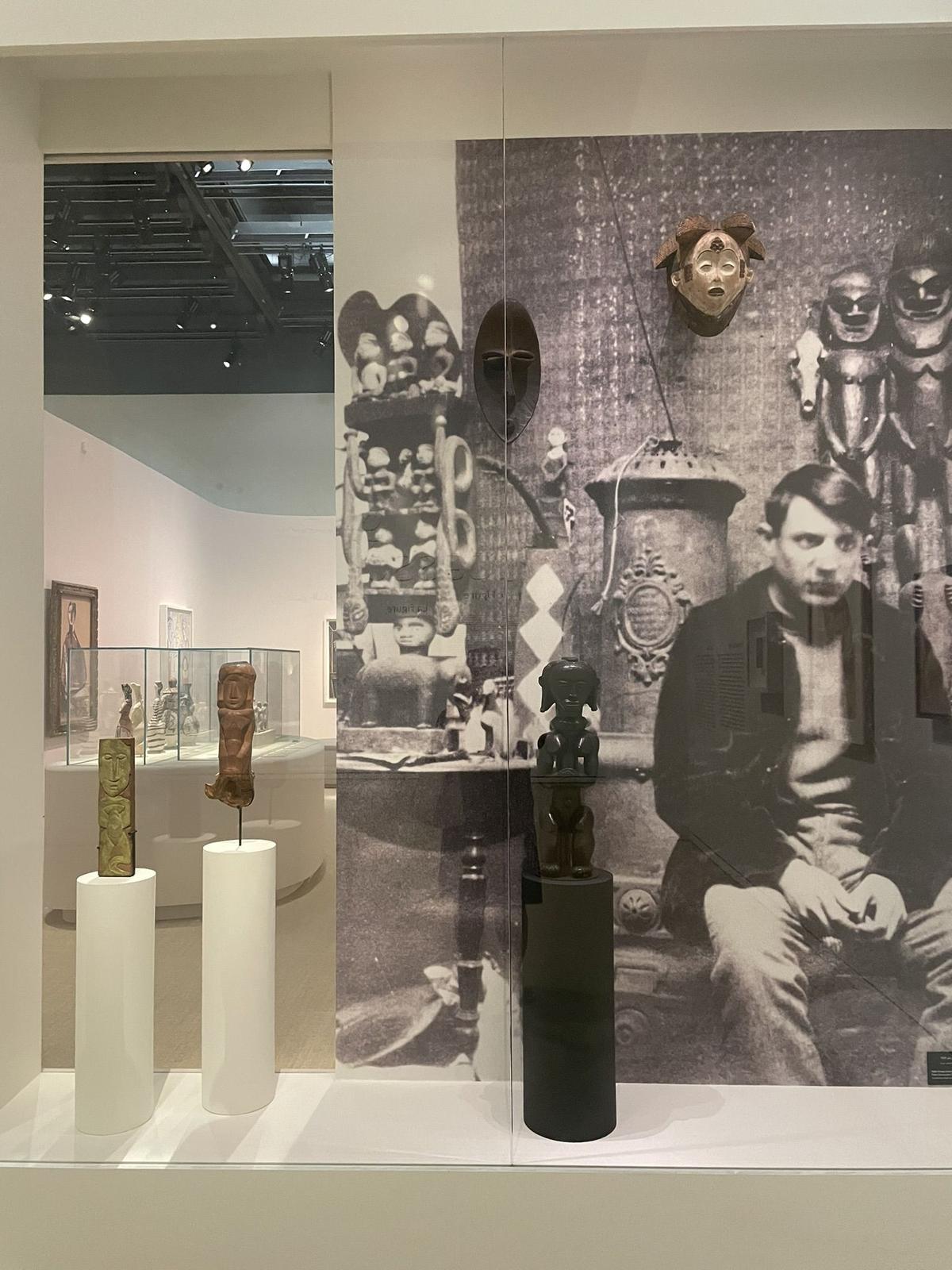
To speak of Picasso means speaking of modern art itself
| Photo Credit:
Neeta Lal
To speak of Picasso means speaking of modern art itself. Few artists have altered the course of visual culture with such invention, audacity and range. Across more than seven decades, Picasso refused to be confined by a single style, movement, or medium. He painted, sculpted, sketched, engraved, experimented with ceramics, and dismantled artistic conventions with fearless intensity, only to rebuild them into something entirely new.
What makes Picasso, the Figure compelling is how elegantly it captures the breadth of that genius. This is not merely an exhibition about Cubism, nor a collection of familiar masterpieces, but an immersive journey through an extraordinary oeuvre. It reveals an artist whose imagination spilled effortlessly across painting, sculpture, drawing, and experimental forms with astonishing energy.
Spread across a series of impeccably designed galleries, the exhibition brings together around 60 important works exploring Picasso’s fascination with the human figure — from cubist experiments to his neoclassical portraits, surrealist compositions, and boldly expressive late works.
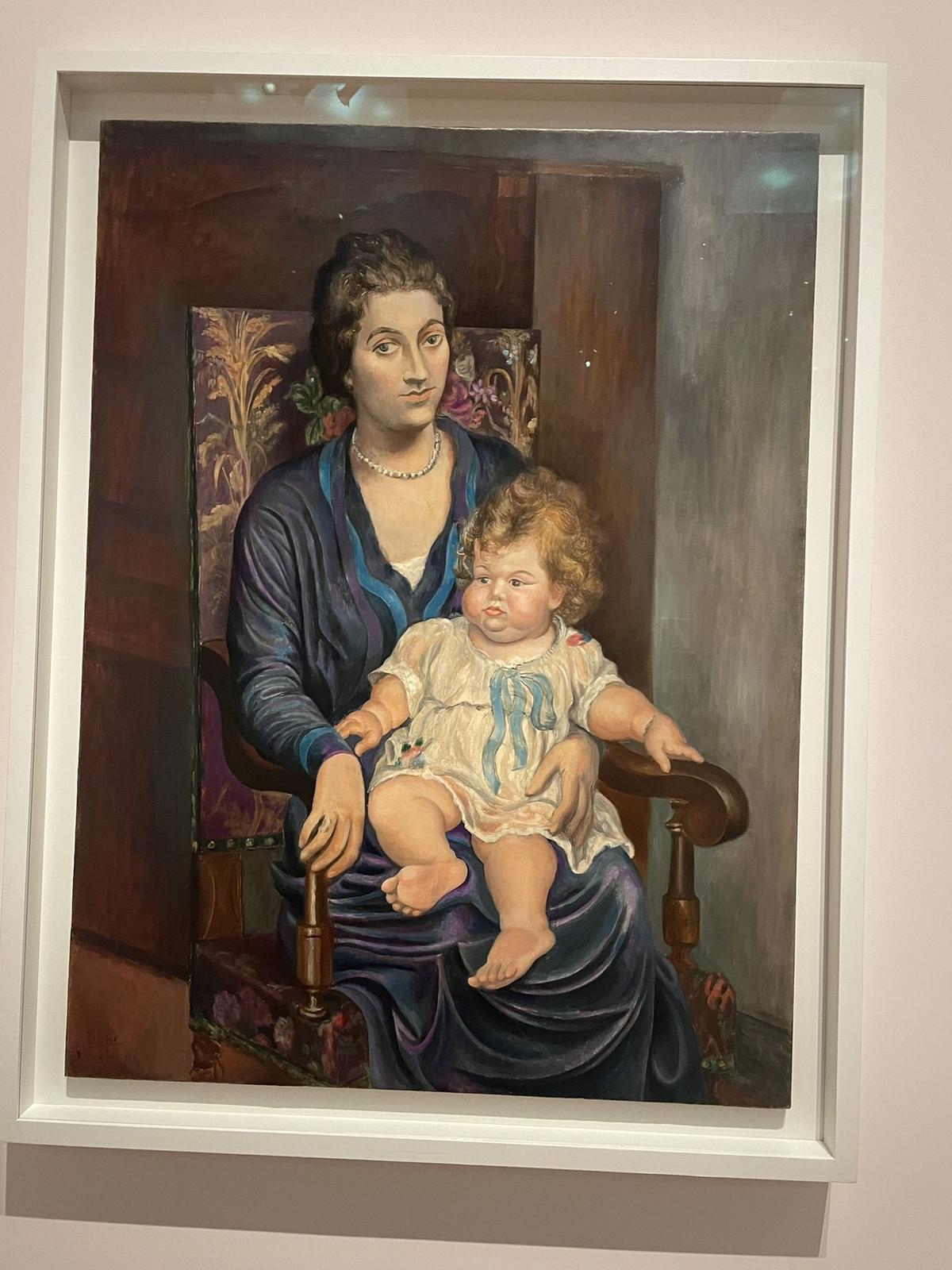
Breadth of a genius, captured in form
| Photo Credit:
Neeta Lal
Picasso’s early portraits still carry traces of academic discipline. Faces appear balanced, recognisable, almost obedient to conventional structure. But as you move deeper into the exhibition, those rules begin to dissolve. Features shift. Profiles fracture. Eyes migrate. Bodies refuse to remain whole.
“Picasso never treated portraiture as an exercise in resemblance,” the guide informs. “For him, the human face was never fixed, but fluid — emotional, fragmented, and psychologically charged.” As one progresses through the galleries, his portraits become increasingly intense, fractured, and disquieting. It becomes impossible not to recall his famous observations: a head, he once remarked, is simply a matter of eyes, nose, and mouth — arranged as one pleases. That philosophy resonates from every wall.
Muses and reinvention
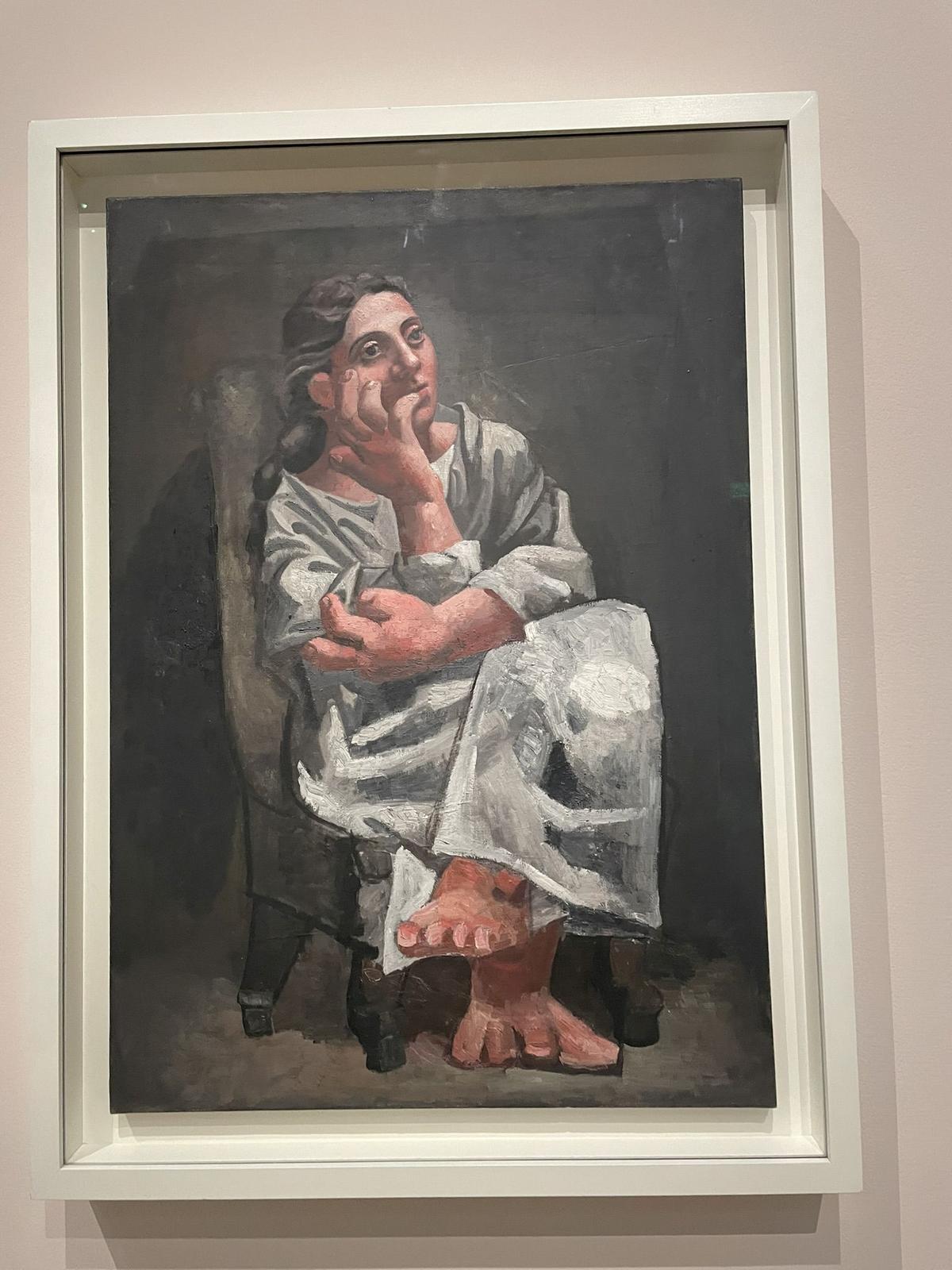
A portrait where stillness speaks louder than words.
| Photo Credit:
Neeta Lal
One of the exhibition’s arresting works is ‘Portrait of a seated woman’ (Olga) from 1923. Depicting a lady named Olga Khokhlova, the painting offers a striking contrast to Picasso’s Cubist experimentation. She sits with quiet elegance, her face turned gently away, expression composed yet elusive.
Following his immersion in classical art and Renaissance masterpieces during travels through Italy, Picasso temporarily returned to a more refined, neoclassical language. The result feels almost sculptural. Olga appears less painted than carved, like a Greco-Roman figure suspended in stillness.
There is tenderness here, but also distance. Admiration, perhaps, tempered by emotional restraint. Further into the exhibition, that softness gives way to something bolder. In ‘Woman in an armchair’ (1947), Picasso turns his attention to Françoise Gilot — artist, muse, and one of the defining women of his later life. But this is no conventional portrait.
Gilot appears transformed into something botanical, almost mythological. Her body elongates like a stem, her limbs branch outward like leaves or claws, and her face blooms within petal-like forms. The work is playful, sensual, and faintly unsettling — all at once.
Standing before it, one begins to understand that Picasso rarely painted women as mere individuals, but . He painted them as forces — emotional, symbolic, transformative. Throughout the exhibition, the maestro’s influences reveal themselves in layers — African masks, ancient mythology, Iberian sculpture, and classical European masters. Picasso absorbed visual languages from across cultures and centuries, only to dismantle them and reconstruct them into something unmistakably his own
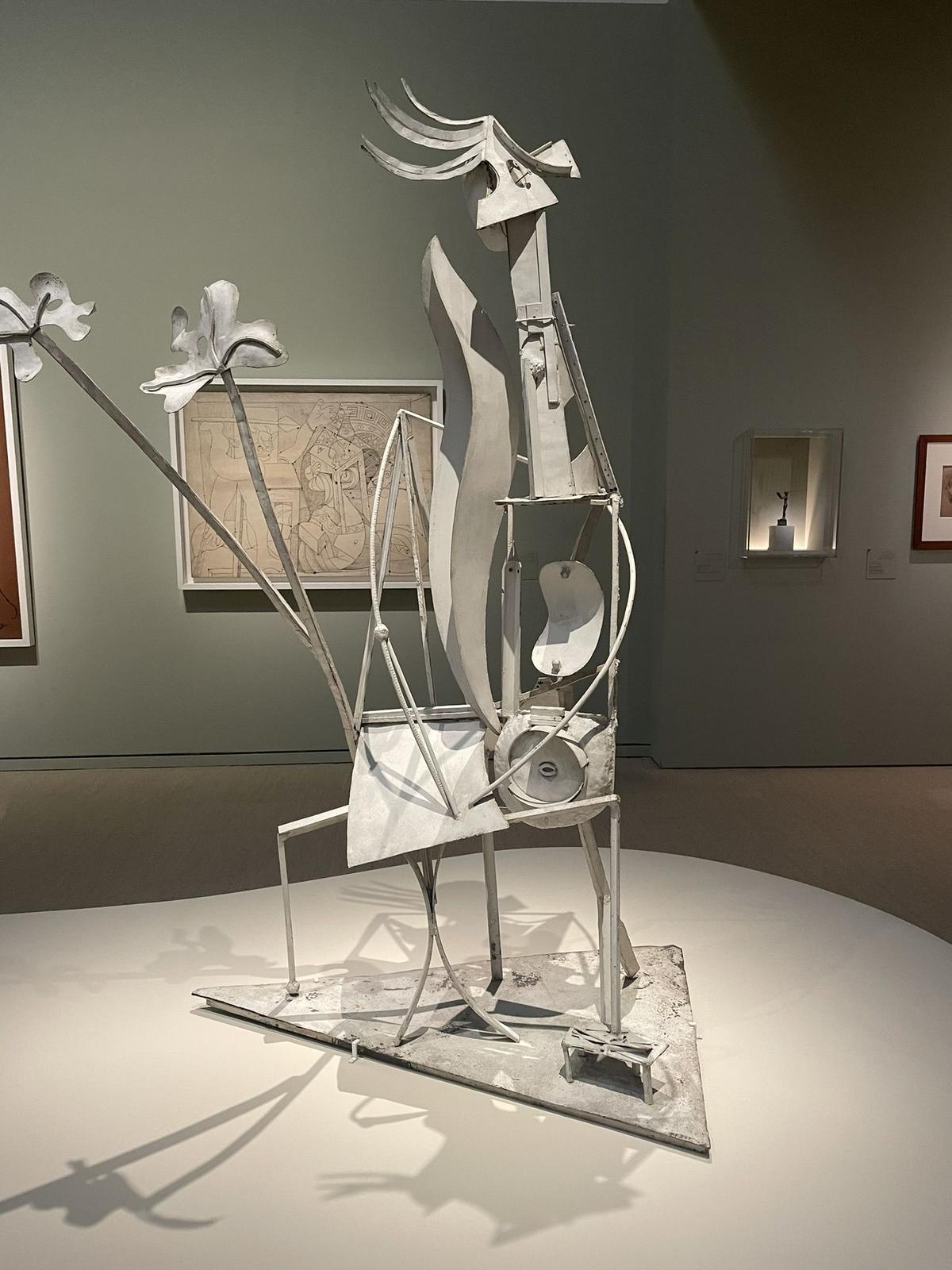
Throughout the exhibition, his influences reveal themselves in layers — African masks, ancient mythology, Iberian sculpture and more.
| Photo Credit:
Neeta Lal
Yet beneath the experimentation, another force quietly begins to dominate: conflict.
As Europe descended into violence, Picasso’s work grew darker, sharper, and emotionally heavier. And nowhere is his legacy felt more powerfully than in the exhibition’s final galleries, where his influence extends far beyond Europe.
In a darkened room, Iraqi artist Dia Al-Azzawi’s monumental ‘Elegy to My trapped city’, presides. Long, horizontal, and emotionally overwhelming, the painting echoes the visual language of Picasso’s anti-war masterpieces while speaking directly to the destruction of Baghdad. Figures writhe across the canvas in anguish, accompanied by the haunting sound of Arabic poetry filling the space.
The effect is devastating.
It is here that Picasso, the Figure transforms from an art historical exhibition into something profound — a conversation across continents and generations, between Spain and Iraq, between memory and destruction, between artistic rebellion and human suffering.
By the time you step back beneath Louvre Abu Dhabi’s shimmering dome, the museum feels different. Families are still wandering. Children running. Phones raised toward perfect compositions.
But after spending time with Picasso, the world itself appears slightly rearranged. And perhaps that, more than anything, is the mark of true genius.